Time has a funny way of pretending it walks in straight lines, yet every now and then it loops around your memories like a curious cat. You look at a calendar, blink once, and somehow a birthday has arrived again or a project deadline is suddenly standing at your front door.
That’s exactly why a Weeks Calculator becomes surprisingly useful. It doesn’t merely count days. It quietly untangles moments, helping you understand where you’ve been and where you’re heading next, which is kinda comforting if you ask me.
Whether you’re planning an important event, tracking a pregnancy, managing a construction schedule, preparing for exams, or simply wondering how many weeks remain until a vacation, a reliable Week Calculator makes life less messy.
Instead of manually flipping through calendar pages or counting tiny boxes one by one, you can calculate weeks accurately in seconds. Funny enough, even people who adore calendars sometimes lose track after the fourth page.
A good calculator isn’t just about numbers. It becomes a tiny companion for planning life. It helps compare dates, estimate timelines, organize projects, and even satisfy random curiosity like “How many weeks have passed since that day?” Sometimes the smallest questions lead to the biggest smiles.
| Feature | Description |
|---|---|
| Purpose | Calculate weeks between two dates |
| Add Weeks | Find a future date by adding weeks |
| Subtract Weeks | Find a past date by subtracting weeks |
| Input | Start date and end date |
| Output | Total weeks and exact dates |
What Is a Weeks Calculator?
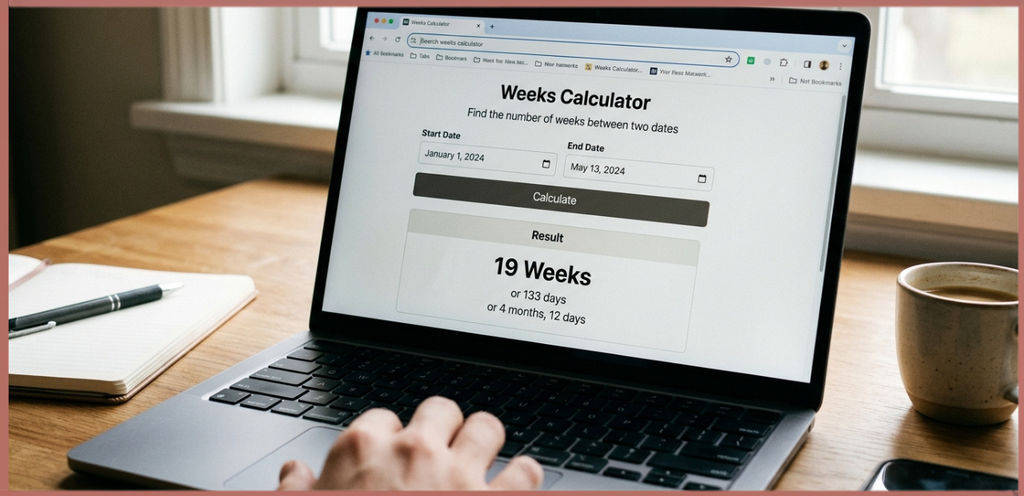
A Weeks Calculator is an online Calculator Tool designed to measure the amount of time between dates or determine future and past weeks from any chosen day. Instead of counting manually, it performs accurate Date Calculation using a standard Calendar system.
Depending on your needs, the calculator can:
- Calculate Weeks Between Dates
- Add Weeks to a selected date
- Subtract Weeks from a chosen day
- Find the Number of Weeks between two events
- Predict future or past dates with remarkable accuracy
Behind the scenes, it performs Date Arithmetic, comparing your Start Date, End Date, or Reference Date before generating the correct Date Output.
Why Counting Weeks Is More Useful Than Counting Days
Days feel tiny. Months feel huge. Weeks sit somewhere comfortably in the middle, which honestly makes planning feel more natural.
Imagine planning:
- School semesters
- Fitness transformations
- Wedding preparation
- Pregnancy milestones
- Vacation countdowns
- Business launches
- Home renovation schedules
Thinking in weeks often provides a clearer picture than counting individual days.
A seven-day chunk creates manageable goals. Your brain somehow likes neat little packages of time, even if it refuses to admit it.
How a Week Calculator Works
A modern Week Calculator performs several simple operations simultaneously.
First, you select a Start Date.
Next, choose an End Date or enter the number of weeks you’d like to add or subtract.
The system compares both Calendar Dates, processes the chosen Operation Type, and returns accurate results.
Typical components include:
- Input Fields
- Calculate Button
- Clear Button
- Reference Date
- Date Range
- Date Interval
- Week Interval
- Generated Date Output
This workflow feels effortless because all the complex Chronological Calculation happens behind the scenes.
Common Ways People Use a Weeks Calculator
People often think only students or accountants need calculators, but that’s not really true. Almost everyone ends up needing one sooner or later.
Popular examples include:
- Tracking pregnancy weeks
- Planning business launches
- Scheduling academic semesters
- Calculating employee probation periods
- Monitoring construction timelines
- Planning sports seasons
- Organizing marketing campaigns
- Managing subscription renewals
- Counting weeks until retirement
- Tracking long-term savings goals
Every one of these situations depends on accurate Week Counting and reliable Date-Based Calculations.
Calculating Weeks Between Dates
One of the most common tasks is finding Weeks Between Dates.
Instead of counting manually across multiple months, the calculator instantly performs Date Comparison and calculates the complete Week Difference.
Suppose your Start Date is December 1, 2022, while your End Date is December 25, 2024.
The calculator analyzes the complete Date Range, measures the Elapsed Time, and displays the total Week Count without requiring manual calculations.
This is especially useful for project management, payroll planning, and long-term scheduling.
Add Weeks to Any Date
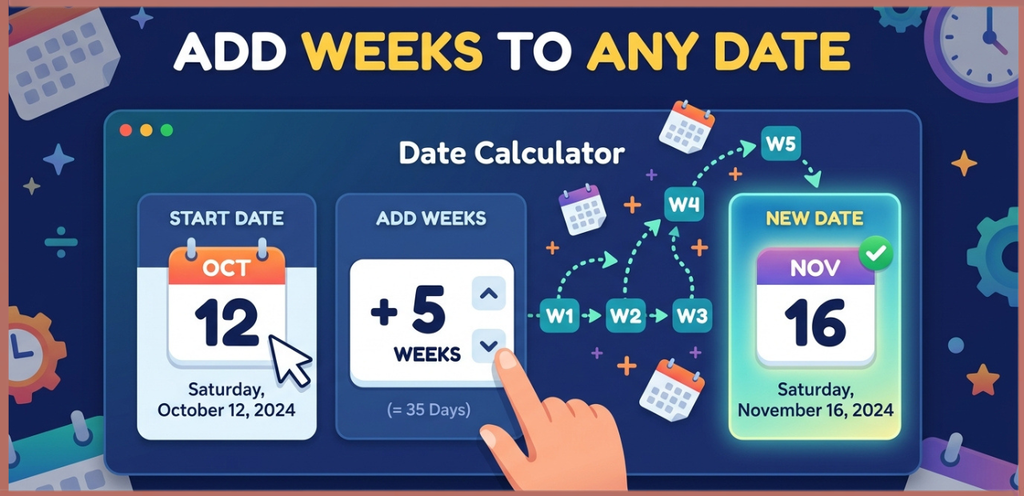
Sometimes you’re less interested in today’s date than the one waiting several weeks ahead.
Using the Add Weeks feature, you simply enter a Base Date, choose the desired number of weeks, and receive the exact future calendar date.
Examples include:
- 7 Weeks
- 14 Weeks
- 20 Weeks
If your Reference Date is October 6, 2026, adding 20 Weeks leads you directly to March 1, 2027.
This process relies on accurate Future Date Calculation instead of rough estimates.
Subtract Weeks From a Date
Planning isn’t always about the future.
Sometimes you need to know what happened weeks ago.
The Subtract Weeks option helps identify previous dates quickly.
People often use it for:
- Medical appointments
- Pregnancy tracking
- Payroll history
- School attendance
- Tax documentation
- Legal deadlines
Rather than counting backwards manually, the calculator performs precise Date Subtraction using accurate Calendar Math.
Weeks From Now Calculator
The Weeks From Now Calculator focuses entirely on future planning.
You simply choose today’s date or another Base Date, enter the desired number of weeks, and receive the final result.
This feature proves useful when scheduling:
- Conferences
- Wedding ceremonies
- Product launches
- Academic exams
- Holiday travel
- Fitness milestones
Instead of wondering “How many weeks until then?” the calculator gives immediate clarity.
Weeks Ago Calculator
The Weeks Ago Calculator works in the opposite direction.
It determines which date occurred a certain number of weeks earlier.
People frequently use this tool when reviewing:
- Previous invoices
- Medical treatments
- Project milestones
- Insurance claims
- Historical events
Accurate Past Date Calculation eliminates uncertainty while improving documentation.
Understanding Week Difference
A Week Difference represents the total number of complete weeks between two dates.
This differs from simply counting months because months vary in length.
Some contain:
- 28 days
- 29 days
- 30 days
- 31 days
Weeks always consist of seven days, making them a consistent unit for Time Measurement.
That’s one reason businesses frequently rely on weekly reporting instead of monthly tracking.
Why Date Calculation Matters

Every serious schedule depends on reliable Date Calculation.
Even a one-day mistake can affect:
- Payroll
- Medical treatments
- Construction deadlines
- University admissions
- Shipping schedules
- Financial reporting
Accurate Date Arithmetic removes guesswork.
It replaces uncertainty with confidence, which feels oddly satisfying.
Calendar Calculator vs Weeks Calculator
Although they seem similar, each serves slightly different purposes.
A Calendar Calculator focuses on broader Calendar Dates, while a Weeks Calculator specializes in week-based measurements.
The first helps visualize entire months.
The second specializes in:
- Week counting
- Week intervals
- Date offsets
- Weekly scheduling
- Duration calculations
Together they complement one another rather nicely.
Time Calculator and Week Calculations
A Time Calculator often measures hours, minutes, and seconds.
A Weeks Calculator instead measures larger Time Periods, making long-term planning easier.
Both rely on the same underlying principles:
- Time intervals
- Date arithmetic
- Chronology
- Duration
- Date formulas
They’re cousins, in a way, just working on different scales.
Understanding Date Ranges
Every calculation starts with defining a proper Date Range.
A date range includes:
- Start Date
- End Date
Once those values are entered, the calculator performs:
- Date Counting
- Week Counting
- Time Difference
- Week Duration
- Chronological Calculation
Accurate input always produces accurate output.
Garbage in, garbage out still applies, sadly.
Features of a Modern Date Calculation Widget
A quality Date Calculation Widget offers far more than basic subtraction.
Common features include:
- Interactive calendars
- Automatic leap year handling
- Week offsets
- Future date predictions
- Historical date lookup
- Mobile responsiveness
- Instant recalculation
- Easy user interface
Good design makes complex calculations feel almost invisible.
Examples of Week Calculations
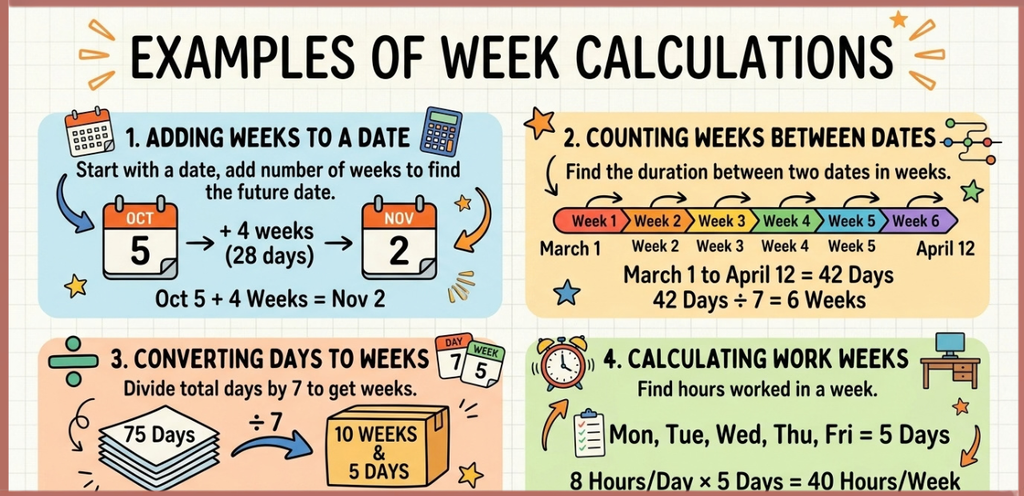
Here are several practical examples.
| Task | Example |
|---|---|
| Add weeks | October 6, 2026 + 20 Weeks = March 1, 2027 |
| Future planning | Add 7 Weeks to a chosen Reference Date |
| Pregnancy tracking | Add 14 Weeks from current milestone |
| Compare dates | December 1, 2022 to December 25, 2024 |
| Event planning | Calculate Weeks Between Dates |
These examples demonstrate how flexible a calculator becomes once different Operation Types are available.
Benefits for Businesses
Companies depend heavily on weekly planning.
Departments frequently calculate:
- Employee schedules
- Manufacturing timelines
- Inventory cycles
- Marketing campaigns
- Customer subscriptions
- Financial quarters
- Software releases
Weekly planning creates consistency while reducing scheduling errors.
Oddly enough, a simple week count can prevent surprisingly expensive mistakes.
Benefits for Students
Students also gain tremendous value from week calculations.
Applications include:
- Exam preparation
- Semester planning
- Assignment deadlines
- Internship schedules
- Graduation countdowns
- Study plans
Breaking large goals into weekly targets feels much less intimidating.
Your future self usually says thank you.
Benefits for Families
Families often rely on weekly schedules more than they realize.
Parents calculate weeks for:
- Pregnancy
- Baby development
- School holidays
- Family vacations
- Medical appointments
- Anniversary planning
Life becomes easier when everyone follows the same timeline.
Well… easier most of the time anyway.
Avoiding Common Calculation Mistakes
Manual calculations often produce errors.
Common mistakes include:
- Forgetting leap years
- Miscounting weekends
- Skipping months
- Counting partial weeks incorrectly
- Using inconsistent reference dates
Using an automated Week Count Calculator removes nearly all of these problems.
Tips for Accurate Week Counting
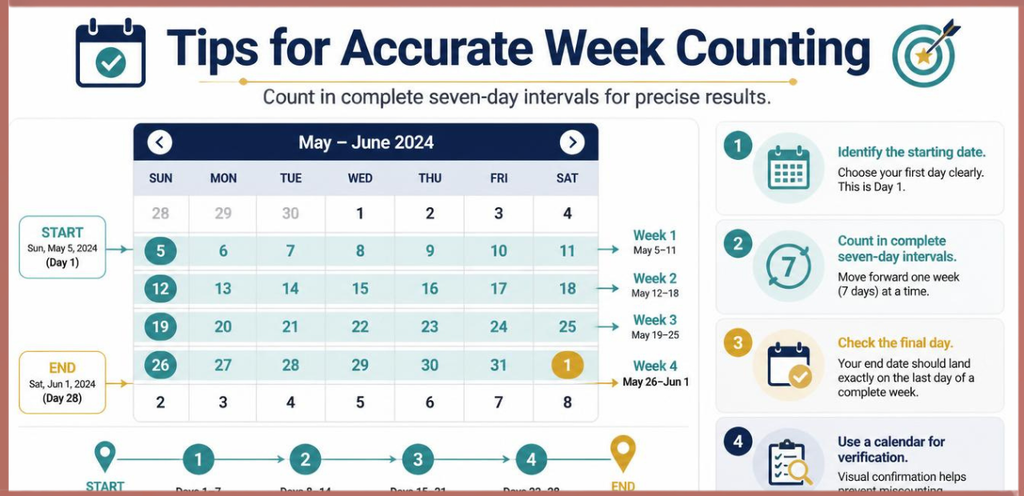
To achieve precise results:
- Verify your Start Date
- Double-check the End Date
- Select the correct Operation Type
- Review your Date Input
- Confirm your calendar settings
- Recalculate if information changes
Small details matter much more than people expect.
Why Online Week Calculators Continue Growing
Online calculators continue becoming more popular because they’re:
- Fast
- Free
- Accurate
- Mobile-friendly
- Easy to understand
- Accessible anywhere
Whether someone needs a Week Interval Calculator, Week Duration Calculator, Week Difference Calculator, Date Interval Calculator, or Date to Date Calculator, modern tools provide instant answers without requiring mathematical expertise.
Frequently Asked Questions About Week Calculations
How many weeks between two dates?
Enter your Start Date and End Date into a Weeks Calculator, and it instantly calculates the Number of Weeks between them using accurate calendar math.
Can I calculate future weeks?
Yes. A Weeks From Now Calculator lets you add any number of weeks to a selected date and returns the exact future calendar date.
Can I calculate past weeks?
Absolutely. A Weeks Ago Calculator subtracts weeks from a chosen date to identify the correct past date.
Is week counting affected by leap years?
Yes. Reliable calculators automatically account for leap years and calendar variations, ensuring precise results.
Why should I use a calculator instead of counting manually?
Manual counting can easily lead to mistakes, especially across long date ranges. An online calculator performs accurate Date Calculation instantly.
Frequently Asked Question
week calculator from date
A week calculator from date helps you calculate a future or past date by adding or subtracting a specific number of weeks from any chosen starting date.
week calculator
A week calculator quickly calculates the number of weeks between two dates or helps you add and subtract weeks with accurate results.
20 weeks from today
20 weeks from today gives you the exact calendar date that falls 20 weeks after today’s date, making long-term planning simple and accurate.
no of weeks calculator
A no of weeks calculator determines the total number of weeks between two dates, making it useful for schedules, projects, and event planning.
week calculation
Week calculation is the process of measuring the number of weeks between dates or finding a date by adding or subtracting weeks from a starting point.
If you’ll be creating more date-calculator pages, I can also help generate these short H3 answers in the same format for each new article.
Conclusion
Time doesn’t pause simply because we’re busy. It keeps moving with gentle determination, carrying birthdays, meetings, milestones, memories, and fresh beginnings along with it.
A dependable Weeks Calculator transforms complicated Date Calculations into quick, reliable answers, helping you confidently measure Weeks Between Dates, Add Weeks, Subtract Weeks, calculate Week Difference, and organize every important timeline.
Whether you’re managing a business project, preparing for exams, tracking pregnancy milestones, planning vacations, or simply satisfying your curiosity about how many weeks between two moments, a well-designed week calculation tool makes the process wonderfully simple. Instead of wrestling with calendars or second-guessing your math, you can focus on what truly matters using your time wisely.
If this guide helped you better understand weekly date calculations, feel free to share it with friends or colleagues who might find it useful.
And if you have a favorite way of using a weeks calculator, or an interesting planning story, share your experience in the comments. Time keeps moving either way, but planning it just got a little bit easier.