There is something oddly satisfying about watching numbers suddenly make sense. One minute you’re staring at a recipe asking for 250 grams of honey while your measuring cup only speaks in milliliters, and the next minute everything clicks.
It kinda feels like translating two friends who speak different languages but are trying very hard to bake the same cake. Measurements, funny enough, have their own tiny stories hidden inside them.
Whether you’re preparing dinner, mixing homemade cosmetics, working on a science assignment, or simply trying not to ruin a batch of cookies, knowing how to convert grams to milliliters is one of those little skills that keeps proving useful. It isn’t magic, even if it sometimes feels like it. The secret sits quietly inside one important value: Density.
This guide explains everything you need to know about Grams, Milliliters, g to ml, ml to g, conversion formulas, density tables, and practical examples. Along the way, you’ll discover why some ingredients behave so politely while others insist on being wonderfully complicated.
Convert Grams to Milliliters (g to ml, ml to g)
| Conversion | Formula | Example |
|---|---|---|
| Grams to Milliliters (g → ml) | ml = g ÷ density | 100 g of water = 100 ml |
| Milliliters to Grams (ml → g) | g = ml × density | 100 ml of water = 100 g |
| Water (Density = 1 g/ml) | 1 g = 1 ml | 250 g = 250 ml |
| Milk (≈1.03 g/ml) | ml = g ÷ 1.03 | 100 g ≈ 97 ml |
| Cooking Oil (≈0.92 g/ml) | ml = g ÷ 0.92 | 100 g ≈ 109 ml |
| All-Purpose Flour (≈0.53 g/ml) | ml = g ÷ 0.53 | 100 g ≈ 189 ml |
| Granulated Sugar (≈0.85 g/ml) | ml = g ÷ 0.85 | 100 g ≈ 118 ml |
Understanding Grams and Milliliters
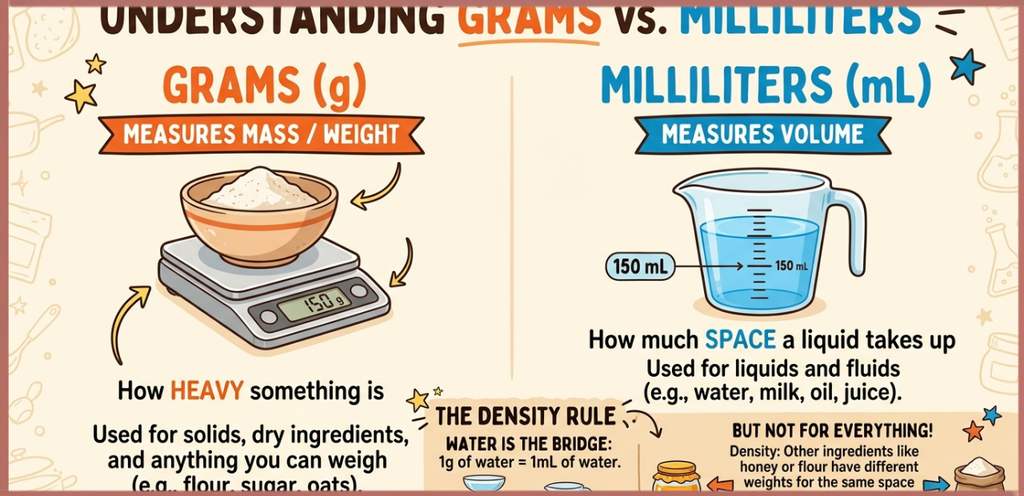
People often think grams and milliliters measure the same thing. They don’t, and thats where most confusion begins.
Grams measure Mass, which tells us how much matter an object contains. Milliliters measure Volume, meaning how much space a substance occupies.
Because they measure different physical properties, converting directly between them always requires knowing the Density of the material.
Think about this for a second.
A cup filled with feathers and another filled with syrup can have the same Volume, yet their Mass is dramatically different. Space stayed the same. Weight didn’t. It’s a small idea that explains nearly every conversion you’ll ever make.
The relationship depends on:
- Mass measurement
- Volume measurement
- Material density
- Measurement units
- Metric units
- Scientific measurement
Convert Grams to Milliliters Using Density
When people search for convert grams to milliliters, they’re actually asking a density question.
The basic Density formula is:
Density = Mass ÷ Volume
Rearranging the equation gives the conversion formula:
Milliliters = Grams ÷ Density (g/ml)
This simple equation powers almost every Grams to Milliliters Converter, Conversion calculator, and Measurement calculator available online.
If you’re converting Pure water, life becomes wonderfully easy because Water density 1 g/ml at standard conditions.
Example:
- 100 grams of water = 100 ml
- 250 grams of water = 250 ml
- 500 grams of water = 500 ml
See? Almost too easy, honestly.
Convert Milliliters to Grams (ml to g)
The opposite conversion follows another straightforward equation.
Grams = Milliliters × Density (g/ml)
Every reliable Milliliters to Grams Converter or Mass calculator uses this formula.
Suppose you have:
- 200 ml of milk
- Milk density ≈ 1.03 g/ml
Calculation:
200 × 1.03 = 206 grams
That’s why recipes written in weight and recipes written in volume sometimes look different even when describing the same ingredient.
Understanding ml to g, convert milliliters to grams, and ml to grams formula prevents those little baking disasters nobody likes talking about.
Why Density Changes Everything
Imagine asking:
“How many grams are in one milliliter?”
The answer depends entirely on the substance.
That’s because Density ratio, or Mass per unit volume, changes from one material to another.
A milliliter of:
- Water
- Honey
- Butter
- Vegetable oil
- Perfume
will never weigh exactly the same.
Some liquids are heavier because their molecules pack closer together. Others spread out more freely.
That’s why every accurate density conversion starts by identifying the ingredient first.
Common influences include:
- Temperature
- Gravity
- Physical properties
- Material properties
- Standard temperature
- Standard pressure
Even though everyday kitchen measurements rarely notice these tiny variations, laboratories certainly do.
Grams to Milliliters Formula Explained
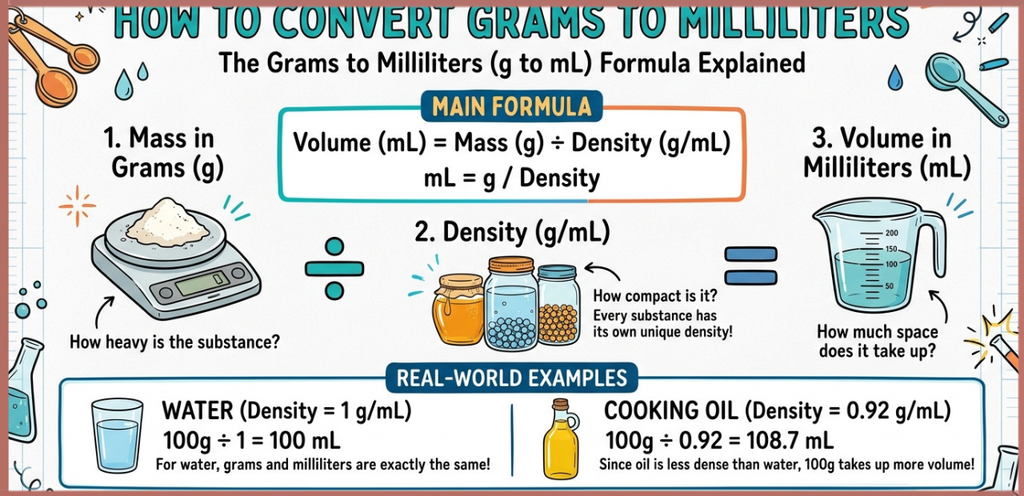
The grams to ml formula can be remembered with one sentence.
Divide the weight by the density.
Formula:
ml = g ÷ density
Examples:
Water
Density = 1 g/ml
150 g ÷ 1 = 150 ml
Honey
Density ≈ 1.42 g/ml
142 g ÷ 1.42 = 100 ml
Coconut Oil
Density ≈ 0.92 g/ml
92 g ÷ 0.92 = 100 ml
Notice how identical volumes can require completely different masses. Thats exactly why ingredient-specific conversions matter.
ml to g Conversion Formula
The reverse calculation is equally useful.
Formula:
g = ml × density
Examples:
100 ml of:
- Milk
- Butter
- Granulated sugar
- Molasses
- Mayonnaise
will each produce different gram values because every ingredient has a different density.
Professional chefs actually prefer weighing ingredients because Mass stays constant while Volume can change depending on packing, moisture, and air pockets.
Grams to Milliliters for Common Ingredients
Below are approximate densities commonly used in kitchens.
| Ingredient | Approximate Density (g/ml) |
|---|---|
| Water | 1.00 |
| Milk | 1.03 |
| Honey | 1.42 |
| Butter | 0.91 |
| Flour | 0.53 |
| Granulated sugar | 0.85 |
| Brown sugar | 0.72 |
| Powdered sugar | 0.56 |
| Vegetable oil | 0.92 |
| Sunflower oil | 0.92 |
| Palm oil | 0.89 |
| Coconut oil | 0.92 |
| Granulated salt | 1.20 |
| Powdered salt | 0.72 |
| Baking soda | 0.96 |
These values are approximate but work well for most everyday Kitchen conversions.
Grams to ml Chart
Here’s a quick grams to ml chart for water.
| Grams | Milliliters |
|---|---|
| 10 | 10 ml |
| 25 | 25 ml |
| 50 | 50 ml |
| 75 | 75 ml |
| 100 | 100 ml |
| 150 | 150 ml |
| 200 | 200 ml |
| 250 | 250 ml |
| 500 | 500 ml |
| 1000 | 1000 ml |
Because Water density 1 g/ml, the values match perfectly.
Milliliters to Grams Table
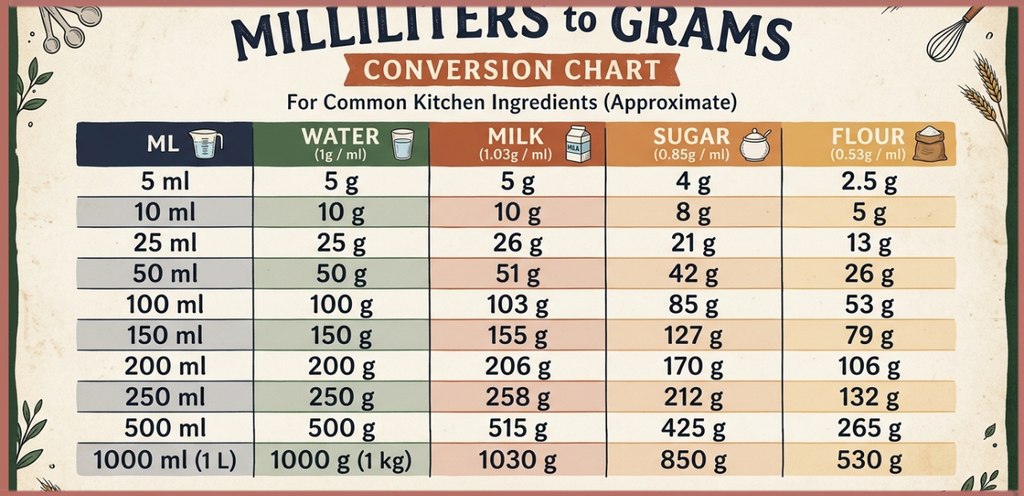
For water, the reverse milliliters to grams table is equally simple.
| Milliliters | Grams |
|---|---|
| 10 | 10 g |
| 50 | 50 g |
| 100 | 100 g |
| 250 | 250 g |
| 500 | 500 g |
| 1000 | 1000 g |
Different substances require different conversion tables because density changes.
Using a Grams to Milliliters Converter
A Grams to Milliliters Converter saves time by automatically applying the density formula.
Most tools ask for:
- Ingredient
- Amount
- Conversion direction
- Desired units
Behind the scenes they use:
- Conversion equation
- Density calculator
- Measurement conversion
- Conversion formula
- Metric conversion
It’s really just mathematics wearing a friendly interface.
Cooking and Baking Conversions
The kitchen is where these calculations become unexpectedly important.
Professional bakers nearly always use:
- Digital Scale
- Measuring cup
- Ingredient-specific density values
Why?
Because one loosely packed cup of Protein flour may weigh differently than another tightly packed cup.
That’s why recipes increasingly recommend gram measurements instead of cups.
Useful applications include:
- Recipe conversions
- Cooking measurements
- Kitchen measurement
- Food measurements
- Recipe ingredient converter
- Cooking ingredient converter
- Kitchen measurement converter
- Baking conversion calculator
- Cooking conversion calculator
- Baking measurement converter
Honestly, your cookies will probably thank you.
Scientific and Chemistry Applications
Outside the kitchen, accurate conversions become even more important.
Scientists routinely convert between:
- Object mass
- Object volume
- Cubic centimeter (cm³)
- Cubic meter
- Kilogram per cubic meter (kg/m³)
- Pound per gallon (lb/gal)
Laboratories rely on precise Chemistry calculations, Chemistry formulas, and Science calculator tools because even tiny errors may affect experiments.
Liquids like:
- Acetone
- Ethanol
- Ethyl alcohol
- Glycerine
- Perfume
- Deodorant
all possess unique density values.
That’s why chemistry students spend so much time learning unit conversions. It may seem repetitive at first, but eventually everything starts fitting together.
Why Some Objects Float While Others Sink
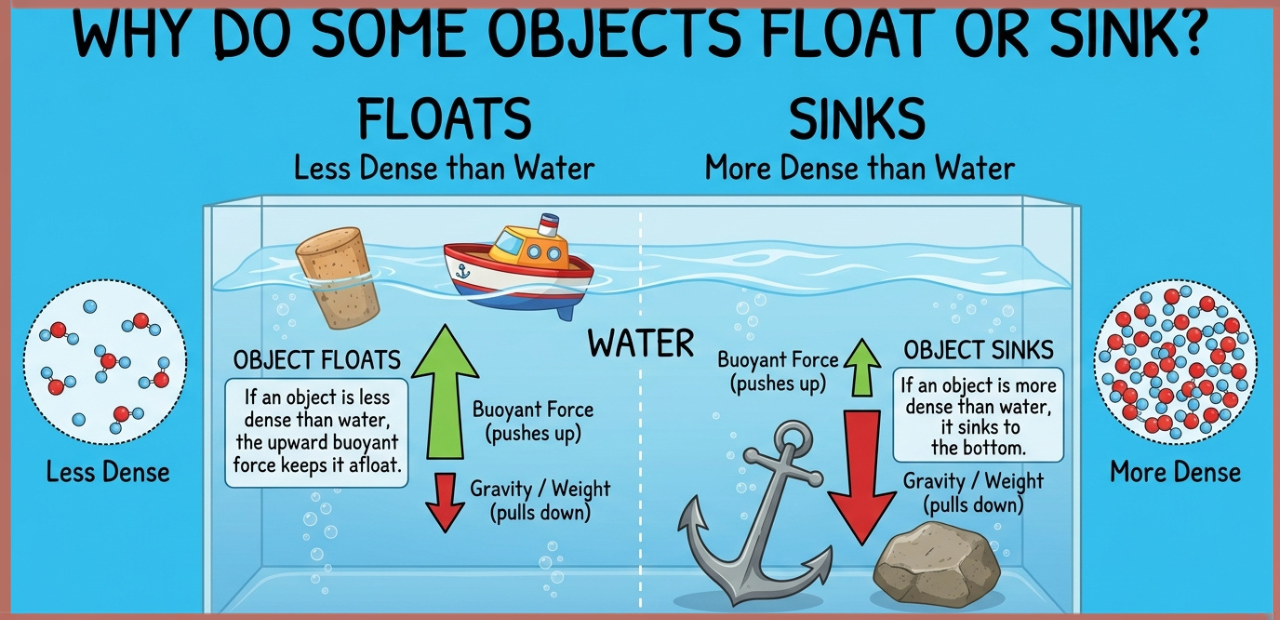
Density also explains everyday observations.
An object with lower density than water tends to be Floating.
If its density becomes greater than water, it starts Sinking.
This isn’t because heavier things always sink.
A massive ship floats because its overall average density stays below water.
A tiny steel ball sinks because its density is higher.
It’s kinda funny how something weighing thousands of tons can float while a spoon disappears instantly.
Frequently Asked Questions
How many grams in a milliliter?
It depends on the substance. Water has approximately 1 gram per milliliter, while honey, oils, and flour all differ because of density.
How many milliliters in a gram?
Again, density determines the answer. One gram of water equals one milliliter, but one gram of flour occupies more space.
Is there an exact conversion?
Only when density is known precisely and measured under controlled conditions.
Why do recipes use grams instead of milliliters?
Weight measurements are usually more accurate and consistent than volume measurements.
Can one formula work for every ingredient?
No. Every ingredient has its own density, which changes the calculation.
Practical Tips for Accurate Measurement Conversion
Small habits often make surprisingly big differences.
- Use a digital Scale whenever possible.
- Choose a proper Measuring cup for liquids.
- Check ingredient density before converting.
- Keep ingredients at normal room Temperature when practical.
- Don’t assume every liquid behaves like water.
- Double-check formulas for baking recipes.
- Use trusted Conversion calculator tools when precision matters.
These tiny steps reduce mistakes far more than most people expect.
Frequently Asked Question
230 g to cups
230 g to cups depends on the ingredient being measured. For water, 230 grams is about 0.97 cups, but flour, sugar, butter, and other ingredients convert differently due to density.
how many cups is 230 grams
How many cups is 230 grams has no single answer because grams measure weight while cups measure volume. Always check the ingredient or use a conversion chart for accurate results.
390 grams to cups
390 grams to cups varies by ingredient. For water, 390 grams is approximately 1.65 cups, while dry ingredients like flour or sugar will have different cup values.
370 grams to cups
370 grams to cups is not a fixed measurement. For water, it equals about 1.56 cups, but the exact conversion depends on the ingredient’s density.
230g to cups
230g to cups is approximately 0.97 US cups for water. If you’re measuring ingredients like flour, butter, or honey, use an ingredient-specific conversion for the most accurate result.
Read this blog https://brinleyo.com/week-calculator/
Final Thoughts
Learning to convert grams to milliliters and convert milliliters to grams isn’t about memorizing endless numbers. It’s about understanding one beautifully simple idea: Density connects Mass and Volume.
Once you understand that relationship, every Unit conversion, Measurement conversion, weight to volume conversion, volume to weight conversion, grams conversion, milliliters conversion, liquid conversion, ingredient converter, food density chart, liquid density calculator, weight and volume converter, and conversion chart suddenly becomes much easier to understand.
Whether you’re measuring Water, Milk, Honey, Flour, Butter, Vegetable oil, Beer, Molasses, Baking soda, Granulated sugar, or another ingredient, remember that the correct answer always begins with density.
It’s the quiet little detail that makes every accurate conversion possible, even if it doesn’t always get the attention it deserves. Sometimes the smallest idea carries the biggest truth, and this one certainly does.