Cooking, baking, preparing drinks, and measuring everyday ingredients all have one small thing in common: sometimes the recipe gives you grams when you only have a milliliter measuring cup.
It can feel like a tiny kitchen puzzle, especially when you’re halfway through mixing a cake and the flour is already on the counter. Luckily, learning to convert grams to milliliters and back again is much easier once you understand one important detail.
Grams and milliliters are both common metric units, but they measure different things. Grams measure mass, while milliliters measure volume.
Because different substances have different densities, 100 grams of water does not necessarily occupy the same volume as 100 grams of flour, honey, or cooking oil. That’s the little secret behind accurate measurement.
In this guide, you’ll learn how grams to milliliters conversion works, how to reverse the calculation, which formulas to use, and how to measure everyday ingredients without unnecessary guesswork.
Whether you’re following a family recipe, preparing a homemade drink, or working with a science experiment, these practical examples will help you get the numbers right.
| Conversion | Formula |
|---|---|
| Grams to Milliliters (g → ml) | ml = g ÷ density |
| Milliliters to Grams (ml → g) | g = ml × density |
| Water | 1 g = 1 ml |
| Cooking Ingredients | Density varies (e.g., flour, sugar, oil), so conversions differ. |
How to Convert Grams to Milliliters
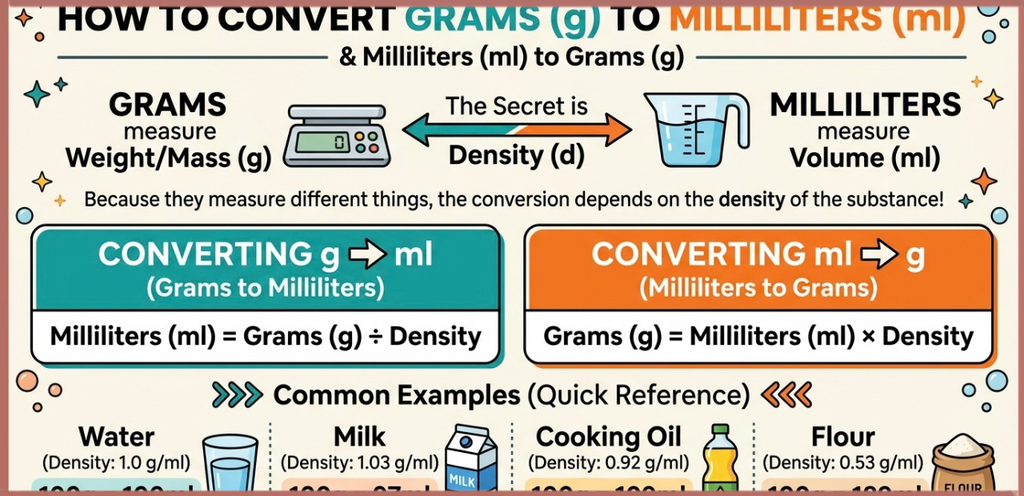
To convert grams to milliliters, you need to know the density of the substance you’re measuring. Density describes how much mass fits into a particular volume. It explains why two ingredients can weigh the same but take up different amounts of space in a measuring cup.
For example, water has a density close to 1 gram per milliliter under ordinary conditions. That means 100 grams of water occupies approximately 100 milliliters. Flour, on the other hand, is much less dense when loosely packed, so 100 grams of flour takes up considerably more space.
The basic steps are simple:
- Identify the substance you want to measure.
- Find its density in grams per milliliter (g/ml).
- Divide the mass in grams by the density.
- The answer is the volume in milliliters.
The calculation uses this formula:
Milliliters=DensityGrams
Suppose you have 200 grams of a liquid with a density of 0.8 g/ml. Divide 200 by 0.8, and you get 250 ml. It’s a straightforward calculation, though you should always use the density of the actual substance rather than assuming everything behaves like water.
A measurement converter can make this process quicker by handling the arithmetic for you. You enter the mass and the appropriate density, and the result gives you the estimated volume.
How to Convert Milliliters to Grams
The reverse calculation is useful when a recipe gives you a volume but your kitchen scale measures mass. To convert milliliters to grams, multiply the volume by the density of the ingredient.
The formula is:
Grams=Milliliters×Density
Imagine that you have 250 ml of cooking oil with an approximate density of 0.92 g/ml. Multiply 250 by 0.92, and the result is 230 grams.
This calculation is especially handy for recipes, food preparation, and laboratory work. A measuring jug tells you how much space a liquid occupies, while a digital scale tells you how much it weighs in everyday terms. With the correct density, you can move between these two types of measurements.
Here are a few simple examples:
- 100 ml of water is approximately 100 grams.
- 100 ml of a liquid with a density of 0.9 g/ml is approximately 90 grams.
- 100 ml of a liquid with a density of 1.2 g/ml is approximately 120 grams.
These examples show why a reliable ml to g converter needs more than just a number. It also needs to know which substance you’re measuring.
Grams to Milliliters Conversion Formula
The grams to ml formula comes from the standard relationship between mass, volume, and density. Density is the amount of mass contained in a particular volume, so you can rearrange the equation to calculate either quantity when the other two are known.
The density formula is:
Density=VolumeMass
Rearranging it gives the grams-to-milliliters formula:
Volume=DensityMass
When mass is measured in grams and density is expressed in g/ml, the calculated volume will be in milliliters.
Consider 150 grams of honey with an illustrative density of 1.42 g/ml:
150÷1.42≈105.63 ml
Therefore, 150 grams of honey occupies approximately 105.6 ml at that assumed density. The precise value may vary with the honey’s composition and temperature, so this is an estimate rather than a universal measurement.
Remember that the formula works for liquids and solids alike. The important part is having a suitable density value for the material you’re measuring.
Milliliters to Grams Conversion Formula
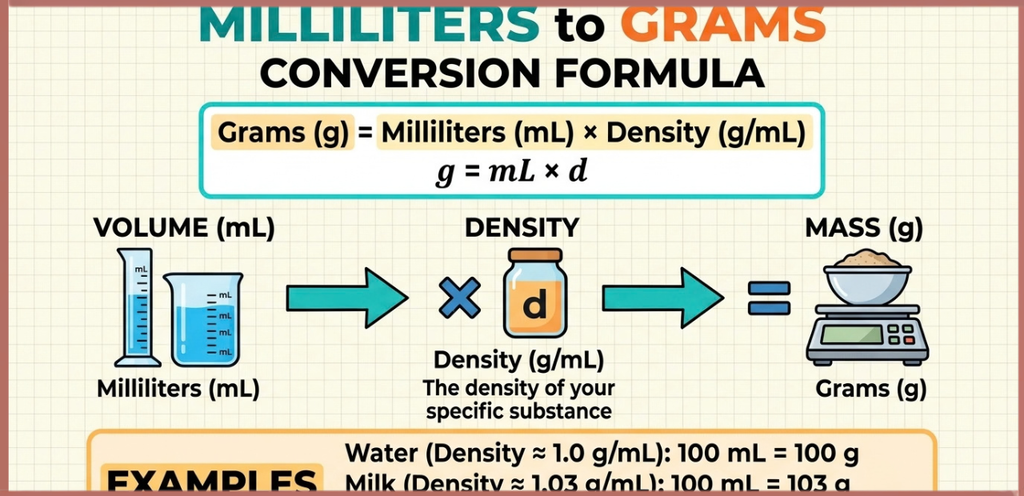
The milliliters to grams conversion formula follows the same density principle, but the multiplication and division switch places.
Mass=Volume×Density
If you know the volume in milliliters and the density in g/ml, multiply the two values to find the mass in grams.
For example, suppose you have 300 ml of milk and use an approximate density of 1.03 g/ml.
300×1.03=309 g
The estimated mass is 309 grams. This is more accurate than simply treating the milk as water, although the real result can vary depending on the milk’s fat content and composition.
You can use this conversion formula for many materials, including oils, syrups, cleaning liquids, and laboratory substances. Always confirm that the density units match the units in your calculation.
Grams to Milliliters Conversion Table for Water
Water is the easiest place to begin because its density is approximately 1 g/ml under ordinary conditions. As a result, the number of grams and the number of milliliters are nearly identical for everyday water measurements.
The following grams to milliliters conversion table assumes a water density of approximately 1 g/ml.
| Mass (grams) | Volume (milliliters) |
|---|---|
| 1 g | 1 ml |
| 5 g | 5 ml |
| 10 g | 10 ml |
| 20 g | 20 ml |
| 50 g | 50 ml |
| 100 g | 100 ml |
| 150 g | 150 ml |
| 200 g | 200 ml |
| 250 g | 250 ml |
| 500 g | 500 ml |
| 750 g | 750 ml |
| 1,000 g | 1,000 ml |
This table makes everyday calculations easy. If you need 250 grams of water for a recipe, you can measure approximately 250 ml instead. For greater scientific precision, remember that water’s density changes slightly with temperature and is not exactly 1 g/ml under every condition.
Milliliters to Grams Conversion Table for Water
If your recipe lists water in milliliters but your scale measures grams, this reverse conversion table can save you a few calculations. Since water’s density is close to 1 g/ml, the values are approximately equal.
| Volume (milliliters) | Mass (grams) |
|---|---|
| 1 ml | 1 g |
| 5 ml | 5 g |
| 15 ml | 15 g |
| 30 ml | 30 g |
| 50 ml | 50 g |
| 100 ml | 100 g |
| 150 ml | 150 g |
| 200 ml | 200 g |
| 250 ml | 250 g |
| 350 ml | 350 g |
| 500 ml | 500 g |
| 1,000 ml | 1,000 g |
For quick cooking measurements, these rounded values are normally convenient. However, if you’re measuring a different liquid, don’t automatically copy the water values. Milk, oil, honey, and other substances have their own densities.
How Density Affects Grams and Milliliters
Density is the key to understanding why grams and milliliters do not always have a one-to-one relationship. A dense material contains more mass in a given volume, while a less dense material contains less mass in that same space.
For example, a milliliter of honey generally has more mass than a milliliter of water. A milliliter of many cooking oils has less mass than a milliliter of water. Both liquids can occupy exactly the same volume, yet their masses are different.
Three concepts help make the distinction clearer:
- Mass: The amount of matter in a substance, commonly measured in grams or kilograms.
- Volume: The amount of space a substance occupies, commonly measured in milliliters or liters.
- Density: The relationship between mass and volume, commonly measured in g/ml.
A density conversion may also be necessary when a reference gives density in kilograms per liter or grams per cubic centimeter instead of g/ml. Fortunately, some of these units have numerically equivalent values.
For example, 1 g/cm³ equals 1 g/ml because one cubic centimeter occupies the same volume as one milliliter. Similarly, 1 kg/L is numerically equivalent to 1 g/ml.
If you use a density value from a scientific reference, check the measurement conditions. Temperature and pressure can affect density, especially for gases and some liquids.
Standard temperature and pressure conditions are important in technical work, although ordinary kitchen conversions usually use practical, approximate values.
Grams to Milliliters Conversion for Different Ingredients
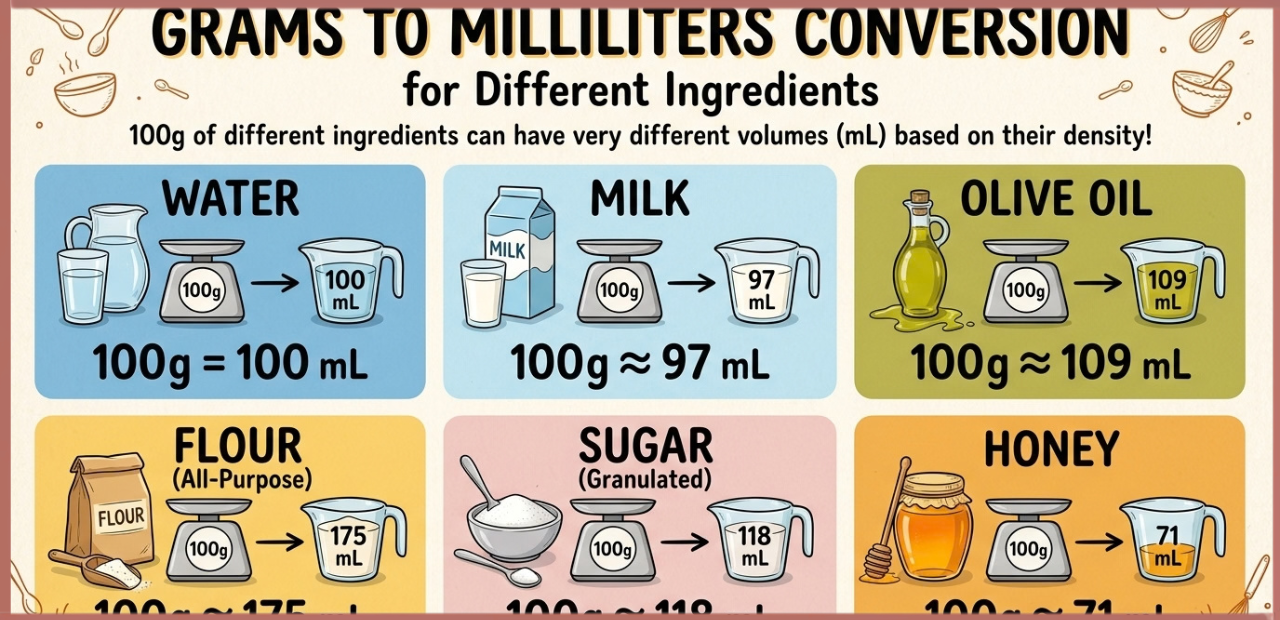
When cooking, the ingredient matters just as much as the quantity. The grams to milliliters for cooking calculation can produce very different results depending on whether you’re measuring flour, sugar, butter, or a liquid.
The estimates below are illustrative. Actual values can change with the ingredient type, packing, temperature, and preparation method.
| Ingredient | Approximate density | 100 grams in ml |
|---|---|---|
| Water | 1.00 g/ml | 100 ml |
| Milk | 1.03 g/ml | 97 ml |
| Sunflower oil | 0.92 g/ml | 109 ml |
| Honey | 1.42 g/ml | 70 ml |
| Granulated sugar | 0.85 g/ml | 118 ml |
| All-purpose flour | 0.53 g/ml | 189 ml |
| Melted butter | 0.91 g/ml | 110 ml |
These estimates show why using a single conversion factor for all ingredients can lead to mistakes. Flour is particularly sensitive to how it is scooped or packed, while honey’s density varies with its moisture content and variety.
Water Grams to Milliliters
For everyday purposes, water is the simplest ingredient to convert. Water grams to ml calculations are nearly one-to-one, so 50 grams is approximately 50 ml and 500 grams is approximately 500 ml.
This makes water useful for practising the formula before moving on to ingredients with different densities.
Milk Grams to Milliliters
Milk is slightly denser than water in many common conditions. Using an approximate density of 1.03 g/ml, 100 grams of milk is around 97 ml.
For the reverse calculation, 100 ml of milk is approximately 103 grams. These figures are useful for everyday recipes, although the exact values depend on the milk’s composition.
Butter Grams to Milliliters
Butter can be tricky because recipes may refer to solid, softened, or melted butter. Its apparent volume changes with its physical state and how it is packed.
For melted butter, an approximate density of 0.91 g/ml gives about 110 ml for 100 grams. When measuring solid butter, using the weight printed on the package is often more reliable than trying to estimate its volume.
Flour Grams to Milliliters
Flour has a much lower bulk density than water because air sits between its particles. As a result, 100 grams of all-purpose flour may occupy roughly 180–190 ml, depending on how it is measured.
This is why baking recipes often work best when flour is weighed directly. Scooping flour tightly into a measuring cup can produce a different result from spooning it in gently.
Honey Grams to Milliliters
Honey is generally denser than water, so a smaller volume can contain the same mass. Using an illustrative density of 1.42 g/ml, 100 grams of honey occupies approximately 70 ml.
If you’re measuring honey for a recipe, lightly coating the measuring spoon or cup with oil can help it slide out more easily. It’s a small trick, but it saves a surprising amount of scraping.
Oil Grams to Milliliters
Many cooking oils are less dense than water. For sunflower oil with an approximate density of 0.92 g/ml, 100 grams occupies about 109 ml.
Coconut oil can behave differently depending on temperature because it may be solid or liquid in an ordinary kitchen. For the best results, follow the recipe’s instructions about whether the oil should be measured before or after melting.
Sugar Grams to Milliliters
Granulated sugar has spaces between its crystals, so its bulk density differs from the density of the sugar material itself. A rough estimate of 0.85 g/ml means 100 grams of granulated sugar occupies around 118 ml.
Brown sugar is often packed into a measuring cup, which increases the mass contained in that volume. Powdered sugar is lighter and more easily compressed, so it needs a separate estimate. For baking, weighing the sugar is generally the most dependable method.
Salt and Baking Soda Conversion
Salt crystals and baking soda have different particle sizes and packing characteristics. Therefore, the same volume of each ingredient may contain different amounts of mass.
If a recipe requires an exact quantity, use a scale or a reliable ingredient-specific conversion reference rather than assuming that one teaspoon or one milliliter always corresponds to a fixed number of grams.
Beer, Alcohol, Glycerine, and Acetone
Density also matters when measuring liquids outside the kitchen. Beer contains water, alcohol, and dissolved substances, so its density varies with alcohol content and residual sugar. Ethanol is less dense than water, while glycerine is considerably denser.
Acetone has a different density again, and its measurements should be based on an appropriate technical reference.
When handling laboratory chemicals, follow the relevant safety instructions and use suitable measuring equipment rather than relying on a kitchen conversion chart.
Common Grams to Milliliters Conversion Examples
Let’s put the formulas to work with some frequently requested calculations. These examples demonstrate how to convert mass to volume and convert volume to mass without getting lost in the numbers.
How to Convert 100 Grams to Milliliters
The answer depends on the substance.
- Water: 100 g is approximately 100 ml.
- Milk: 100 g is approximately 97 ml.
- Sunflower oil: 100 g is approximately 109 ml.
- Honey: 100 g is approximately 70 ml.
The same mass creates different volumes because the ingredients have different densities. If you’re using an online converter, select the ingredient or enter its density before calculating.
How to Convert 500 ml to Grams
To convert 500 ml to grams, multiply 500 by the density of the substance.
- Water: approximately 500 g.
- Milk: approximately 515 g.
- Sunflower oil: approximately 460 g.
- Honey: approximately 710 g.
The values are estimates based on the densities used in this guide. Real measurements can vary, so use a product-specific density when precision matters.
How Many Grams Are in a Milliliter?
There is no universal answer for every substance. One milliliter of water has a mass close to one gram, while one milliliter of oil usually weighs less and one milliliter of honey usually weighs more.
To find the exact relationship, use the substance’s density. When the density is 0.8 g/ml, one milliliter has a mass of 0.8 grams. When the density is 1.4 g/ml, one milliliter has a mass of 1.4 grams.
How Many Milliliters Are in a Gram?
Again, the answer depends on density. For water, one gram occupies approximately one milliliter. For a substance with a density of 0.8 g/ml, one gram occupies 1.25 ml.
The formula is:
Milliliters=Density1
This example assumes a mass of one gram and a density expressed in g/ml.
How to Use a Grams to Milliliters Conversion Calculator
A grams to ml calculator can simplify repeated conversions, particularly when a recipe includes several ingredients. Instead of doing every calculation manually, you enter the quantity and select the relevant substance or its density.
A typical online grams to milliliters conversion calculator follows these steps:
- Choose grams to milliliters or milliliters to grams.
- Enter the quantity you want to convert.
- Select the ingredient or provide its density.
- Check the units to make sure they match.
- Calculate the result and round it appropriately.
For example, if you enter 200 grams of a liquid with a density of 0.8 g/ml, the calculator divides 200 by 0.8 to return 250 ml.
A reverse ml to grams calculator multiplies the volume by the density. For 250 ml of the same liquid, it returns 200 grams.
A calculator is only as accurate as its input data. If you select water while measuring oil, the arithmetic may be correct but the result will not represent the oil’s actual volume or mass.
Understanding Other Metric Conversions
Grams and milliliters are part of a larger measurement system. Knowing a few related relationships can make everyday calculations easier.
Kilograms to Grams
A kilogram contains 1,000 grams. To convert kilograms to grams, multiply the kilogram value by 1,000.
Grams=Kilograms×1,000
For example, 2.5 kilograms equals 2,500 grams. This is a mass conversion, not a volume conversion, so density is not needed.
Milliliters and Cubic Centimeters
One milliliter is equivalent to one cubic centimeter (cm³). Both units describe volume, although milliliters are commonly used for liquids and cubic centimeters appear frequently in science and engineering.
For instance, 50 ml occupies the same volume as 50 cm³. This equivalence makes it easier to work between laboratory measurements and everyday liquid quantities.
Specific Gravity
Specific gravity compares a substance’s density with the density of a reference substance, usually water for liquids and solids. It is a ratio rather than a unit with its own measurement dimensions.
For many everyday calculations, specific gravity can provide a useful approximation of density relative to water. However, the reference temperature and the substance’s conditions still matter when precise results are required.
Common Mistakes to Avoid When Converting Grams and Milliliters
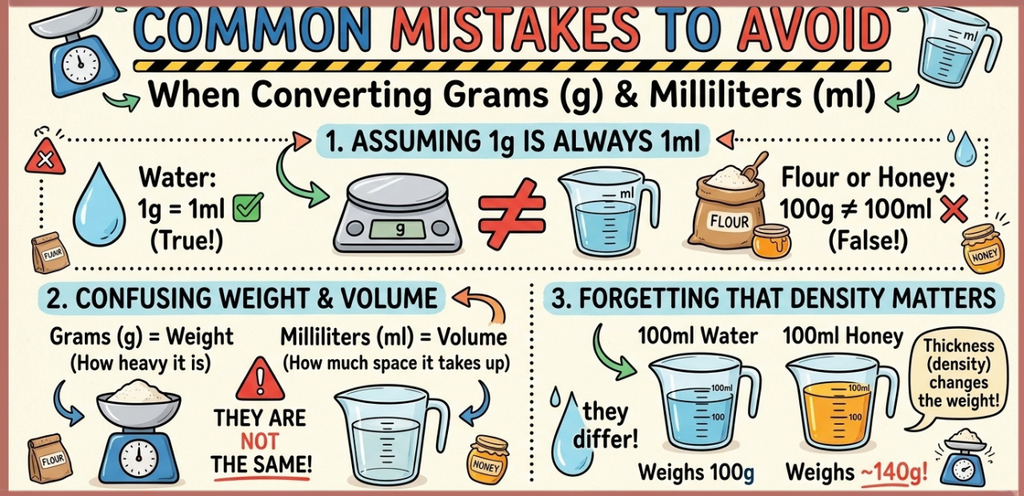
Even a simple unit conversion can produce an incorrect result when the wrong assumptions are used. A few common mistakes are worth watching out for.
- Assuming every substance behaves like water: Only use the one-to-one approximation when it is appropriate for the substance.
- Mixing up mass and volume: Grams measure mass, while milliliters measure volume.
- Using the wrong density units: Convert the density to g/ml before applying the formulas if your original units are different.
- Ignoring ingredient preparation: Melted butter, packed flour, and loose flour may occupy different volumes.
- Rounding too early: Keep a few decimal places during the calculation and round the final answer to a useful level of precision.
- Forgetting temperature: Some substances change density as their temperature changes, which can affect accurate measurement.
The good news is that most everyday errors are easy to prevent. Identify the substance first, check its density, and use the formula that matches the direction of your conversion.
Frequently Asked Questions About Grams to Milliliters
Is 1 Gram Equal to 1 Milliliter?
Not always. One gram is approximately equal to one milliliter for water under ordinary conditions, but other substances have different densities. The relationship depends on the material being measured.
How Do You Convert Grams to Milliliters?
Divide the mass in grams by the substance’s density in g/ml. For example, 100 grams of a substance with a density of 0.8 g/ml occupies 125 ml.
How Do You Convert Milliliters to Grams?
Multiply the volume in milliliters by the substance’s density in g/ml. For example, 200 ml of a liquid with a density of 0.9 g/ml has a mass of 180 grams.
Can I Use the Same Conversion for Every Ingredient?
No. Water, milk, flour, sugar, honey, butter, and cooking oil all have different densities or bulk densities. Use ingredient-specific values for a more reliable result, especially when baking.
Why Do Grams and Milliliters Have Different Values?
Grams measure mass, while milliliters measure volume. Density links the two measurements and explains why equal masses of different substances can occupy different amounts of space.
Is a Grams to Milliliters Calculator Accurate?
A calculator can perform the arithmetic accurately when you enter the correct quantity and density. The final result may still be approximate if the density varies with temperature, composition, or how an ingredient is packed.
What Is the Density Formula for Converting Grams to Milliliters?
The density formula is density equals mass divided by volume. Rearranging it gives volume equals mass divided by density, which is the formula used for grams-to-milliliters conversion.
How Can I Make Ingredient Measurements More Accurate?
Use a digital kitchen scale for mass measurements and a suitable graduated measuring container for volume. For recipes that depend on precise ingredient ratios, weighing ingredients is usually more consistent than estimating their volume.
Practical Tips for Making Every Measurement Count
Good measurement habits are less about memorizing dozens of numbers and more about understanding what you’re measuring. Once you know the difference between mass, volume, and density, a conversion that once seemed confusing becomes a simple calculation.
If you’re preparing a recipe, keep an ingredient-specific chart nearby. For scientific or technical applications, consult a reliable density reference and make sure its units and conditions match your work.
An online calculator is useful for speed, but it cannot automatically correct an unsuitable density value unless the tool has the right substance information.
When sharing your own recipes, consider including both grams and milliliters when appropriate. That small extra step can help readers who use kitchen scales as well as those who rely on measuring jugs and cups.
Most importantly, don’t treat every conversion as an exact one-to-one exchange. Water may make the process look effortless, but flour, honey, oils, and other ingredients each have their own characteristics. Understanding those differences helps you measure with confidence and avoid unnecessary waste.
Frequently Asked Question
45g to ml
45 grams is approximately 45 ml of water. The exact volume depends on the substance’s density.
400g to ml
400 grams is approximately 400 ml of water. For ingredients like flour, sugar, or honey, the volume will differ.
30g to ml
30 grams is approximately 30 ml of water. Other substances may require a different conversion based on density.
40g to ml
40 grams is approximately 40 ml of water. The exact measurement varies depending on the ingredient.
75g to ml
75 grams is approximately 75 ml of water. For other ingredients, use their density to calculate the correct volume.
Read this blog https://brinleyo.com/week-calculator-from-date/
Conclusion
Learning to convert grams to milliliters and convert milliliters to grams is a practical skill that can help in cooking, baking, laboratory work, and many everyday tasks. The central idea is simple: grams measure mass, milliliters measure volume, and density connects the two.
Use milliliters = grams divided by density when converting mass to volume. Use grams = milliliters multiplied by density when converting volume to mass.
For water, the values are approximately equal under ordinary conditions, but other substances require their own density values.
With a suitable conversion table, a reliable calculator, and a little attention to the material being measured, you can handle these calculations without second-guessing every number.
If you have a favorite conversion trick or a question about a particular ingredient, share it in the comments. Your experience might make somebody else’s next recipe a whole lot easier.