Some dates are easy to remember. A birthday, a wedding anniversary, the first day at a new job, or the morning you discover that your family is about to grow.
Other dates are a little harder to keep track of, especially when someone asks how many weeks have passed, how long you have to wait, or what date will arrive after a certain number of weeks. That is where a Weeks Calculator becomes surprisingly useful.
Imagine marking the beginning of an exciting journey on your calendar. Perhaps you are counting down to a holiday, following a pregnancy week by week, planning a study schedule, or working toward a personal goal.
Days can feel endless when you count them one at a time, but weeks provide a clearer picture of how time is moving. Seven days here, fourteen days there, and suddenly a distant milestone starts to feel much closer.
A reliable week-counting tool makes these little calculations easier. Instead of opening a paper calendar and counting each square, you can use a Week Calculator to find the number of weeks between two dates, discover a future date, or work backward to an important day in the past. It saves time, reduces mistakes, and makes ordinary calendar planning feel much less complicated.
In this guide, we’ll explore how a weeks calculator works, when to use one, how to understand date differences, and why week-based planning is helpful in everyday life.
We’ll also look at practical examples, including pregnancy tracking, project deadlines, personal milestones, and weekly schedules, so you can choose the right calculation for your needs.
Weeks Calculator – Quick Reference Table
| Feature | Description |
|---|---|
| Tool Name | Weeks Calculator |
| Purpose | Calculate dates by adding or subtracting weeks from any date. |
| Input | Start date and number of weeks. |
| Calculation | Add or subtract whole weeks (1 week = 7 days). |
| Output | Exact future or past date with the day of the week. |
| Supports | Add Weeks, Subtract Weeks, Weeks Between Dates. |
| 1 Week Equals | 7 Days |
| 4 Weeks Equals | 28 Days |
| 8 Weeks Equals | 56 Days |
| 12 Weeks Equals | 84 Days |
| 20 Weeks Equals | 140 Days |
| Common Uses | Project planning, pregnancy tracking, school schedules, event planning, travel, deadlines, and countdowns. |
Is this conversation helpful so far?
What Is a Weeks Calculator?
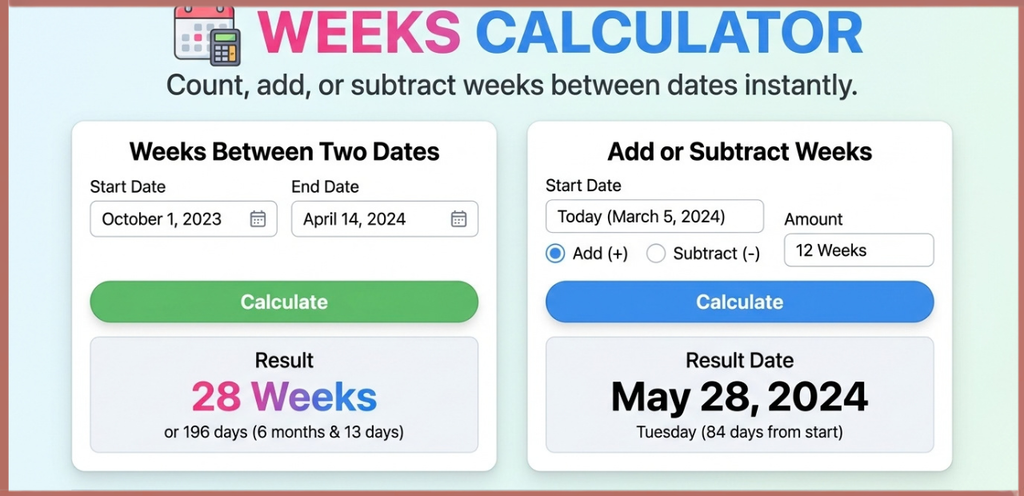
A Weeks Calculator is a digital tool designed to perform calculations involving weeks and calendar dates. It can tell you how many weeks separate two dates, what date falls a certain number of weeks after a starting point, or which date occurred a specified number of weeks earlier.
Think of it as a helpful companion for your calendar. You provide the relevant information, select the calculation you need, and let the tool handle the counting. It is especially useful when a date falls several months away, because manually counting every week across multiple calendar pages can become confusing rather quickly.
For example, you might want to know how many weeks remain until a graduation ceremony or what date you will reach after completing a 20-week fitness program. A suitable calculator can give you a clear answer without requiring you to memorize the number of days in every month.
A good online weeks calculator may offer several functions:
- Calculate the number of weeks between a Start Date and an End Date.
- Add a chosen number of weeks to a particular date.
- Subtract weeks from a starting date.
- Find how many weeks have passed since an event.
- Estimate the number of weeks remaining until a future milestone.
- Support planning for appointments, study schedules, projects, and personal goals.
Some tools display the result as whole weeks and remaining days, while others focus on complete calendar weeks. Understanding that difference is important because two calculators can sometimes display different-looking results while using different counting methods.
How Does a Week Calculator Work?
Most online calculators are designed around a few straightforward steps. You enter a date, choose an operation, provide the number of weeks or a second date, and request the result. The process sounds simple because, honestly, it usually is.
Step 1: Enter the Start Date
The Start Date is the date from which your calculation begins. Depending on the task, it could be today’s date, the beginning of a course, a wedding date, or the first day of a planned project.
For instance, if you began learning a new language on October 11, 2026, that date becomes your starting point. You can use it to calculate how much time has passed or when you will reach a particular weekly milestone.
Step 2: Choose the Operation Type
The Operation Type tells the calculator what you want to find. Common options include Weeks Between, Add Weeks, and Subtract Weeks.
Choose the first option when comparing two dates. Select the second when moving forward on the calendar, and use the third when working backward.
A well-designed interface may include Input Fields, an Operation Type menu, a Calculate Button, and a Clear Button. These controls make it easier to enter new information and correct mistakes without starting the entire process again.
Step 3: Calculate and Review the Result
Once the required information is entered, select Calculate. The tool returns the result according to its calculation method.
Suppose you want to add 7 weeks to a Monday. Seven weeks equal 49 days, so the resulting date will also fall on a Monday, provided the calculation follows ordinary calendar-date arithmetic.
Before relying on the result, check the starting date, the number of weeks, and whether the tool reports complete weeks, total days, or calendar-week boundaries. A quick review can prevent an otherwise avoidable scheduling mix-up.
Weeks Calculator: Calculate Weeks Between Two Dates
One of the most popular uses of a Weeks Calculator is determining the amount of time between two dates. This function is sometimes called a Date Difference Calculator, a Week Difference tool, or a week interval calculator.
Imagine starting a training course on October 11, 2026, and finishing on March 6, 2027. You want to know the Number of Weeks between those dates without counting every day manually.
A calculator can determine the total elapsed days and express the result in weeks and days. This is useful when the interval doesn’t contain an exact number of seven-day periods.
For example, consider a date range of 21 days. That represents exactly three elapsed weeks. A date range of 24 days represents three weeks and three days, rather than four complete weeks.
The distinction matters in situations where a deadline, payment, or appointment depends on the precise length of time between dates.
When Should You Use a Week Difference Calculator?
A week difference calculator is useful for many everyday situations:
- Measuring the time between the beginning and end of a project.
- Finding out how long you have been following a new routine.
- Calculating the duration of a school term or training program.
- Tracking weeks until a holiday or family celebration.
- Reviewing the time between medical appointments.
- Estimating how long a subscription or temporary arrangement has lasted.
- Working out the number of weeks between dates for reports and schedules.
A Date Difference Calculator may also show the total number of days, months, or years between two dates. If you need a precise result, look for a tool that clearly explains whether it uses elapsed time or inclusive date counting.
Understanding Weeks Between Dates
The phrase Weeks Between Dates sounds straightforward, but it can mean slightly different things depending on the situation.
Elapsed-week counting measures the time separating two dates. If one date is exactly 28 days after another, the elapsed duration is four weeks.
Calendar-week counting, however, may count the weekly periods or calendar-week boundaries touched by a date range. A period that begins on Sunday and ends on Monday could cross two calendar weeks despite lasting only one day.
Neither method is automatically wrong. The right one depends on your purpose, so always check the counting convention when working with official schedules or deadlines.
Add Weeks to a Date With Ease
Sometimes you know how long you need to wait but don’t know the exact date when that waiting period ends. A week calculator from date can help you move forward on the calendar without the headache of counting days by hand.
The Add Weeks function is useful for appointments, project milestones, study plans, and personal targets. You enter a starting date, specify the number of weeks, and calculate the resulting date.
For instance, adding four weeks to December 1, 2022, gives December 29, 2022. The result stays within the same calendar year, which makes this an easy example of ordinary date addition.
Now consider a longer interval. If you add 20 weeks to a starting date, the calculator moves forward by 140 days. Because months have different lengths, the resulting date cannot be found reliably by simply adding five months.
This is where proper Date Addition and calendar arithmetic become important.
Practical Uses for Adding Weeks
- Plan a follow-up appointment several weeks after an initial visit.
- Calculate the end date of a 12-week training plan.
- Schedule a project review after a fixed working period.
- Determine when a course will finish.
- Find a date several weeks before an important event so preparations can begin.
- Organize a weekly planner around recurring personal goals.
- Estimate a future milestone using a Future Date Calculator.
The same approach works when you need to add 7 weeks to a particular date or determine an exact date after a longer interval. Just remember that adding seven weeks preserves the day of the week under ordinary date arithmetic.
Subtract Weeks From a Date
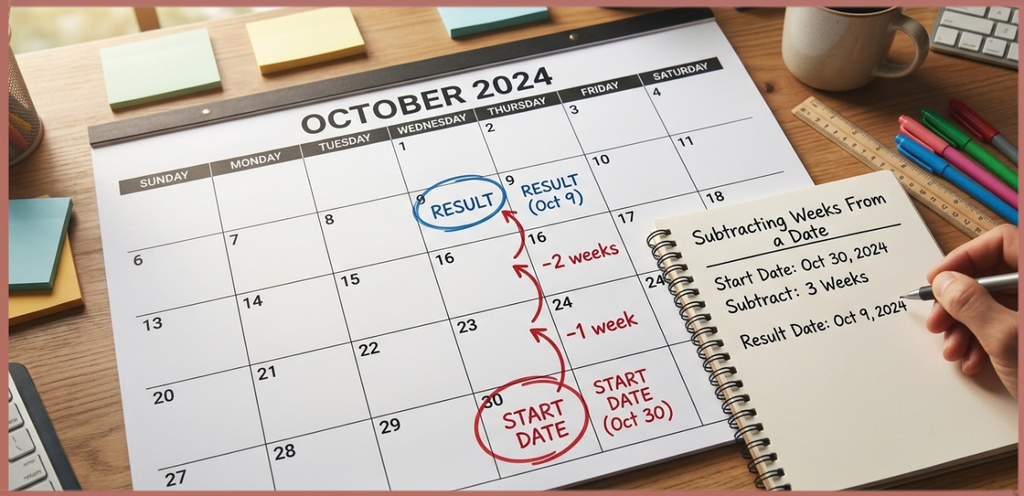
Moving backward is just as useful as moving forward. The Subtract Weeks function helps you identify a previous date by counting backward from a reference point.
Suppose an event is scheduled for December 25, 2024, and you want to know the date 14 weeks earlier. Subtracting 14 weeks means moving backward by 98 days, which takes you to September 18, 2024.
This kind of calculation is helpful when organizing preparation periods, checking historical records, or planning tasks that must be completed before a deadline.
For example, if a conference is scheduled for late summer, you might subtract eight weeks to decide when invitations should be sent. If you’re preparing for an examination, subtracting several weeks from the exam date can help you establish a revision schedule.
When a Past Date Calculator Helps
A Past Date Calculator can help you:
- Find the date a project officially began.
- Determine when a particular training period started.
- Review how many weeks ago an event occurred.
- Plan backward from a deadline.
- Establish an earlier date for a personal or professional milestone.
- Estimate the start of a preparation period.
- Calculate a previous calendar date without manually turning calendar pages.
If you want to subtract 14 weeks from a date, the calculator should subtract 98 days. This is different from subtracting three calendar months, because months vary in length.
That distinction is especially useful when a plan depends on an exact duration rather than a rough estimate.
Weeks From Today: Find Past and Future Dates
There are moments when you don’t have a specific starting date written down. You simply want to know what date falls a certain number of weeks from now, or how long ago something happened.
A Weeks From Now Calculator uses today’s date as the reference point. A Weeks Ago Calculator works in the opposite direction, taking you back through the calendar.
These tools are practical for short-term planning, countdowns, reminders, and personal timelines.
Calculating Weeks From Now
Imagine you’re planning a family gathering and want to know the date 10 weeks from today. Rather than counting through the next two or three calendar pages, enter the number of weeks and calculate the result.
The same method helps you answer questions such as:
- What date will it be three weeks from now?
- How many weeks remain until the end of the year?
- What date falls 20 weeks after an appointment?
- When will a 16-week program finish?
- How many weeks until a planned vacation?
A future date calculator is particularly useful when the target date falls across different months or into a new year.
Calculating Weeks Ago
The opposite question is just as common. You might want to know how many weeks ago you started a job, attended an event, or began a new habit.
A Weeks Ago Calculator lets you enter the number of weeks and find the corresponding past date. If you want to calculate weeks from a date other than today, you can use that date as your reference instead.
For accurate results, keep in mind that a week represents seven days. A period of 35 days is five elapsed weeks, even if it crosses several different calendar months.
Calendar Calculator and Date Difference Tools
A Calendar Calculator is a broader tool that helps with date-based calculations beyond simply counting weeks. Depending on its features, it may calculate days between dates, add or subtract time intervals, or identify future and past calendar dates.
These functions are particularly helpful when your schedule includes several milestones and you need to understand how they relate to each other.
A Date Calculator can be used to find a future date, determine a past date, or measure the duration separating two events. Some tools also work as a Time Interval Calculator, giving results in days, weeks, months, or years.
Understanding Calendar Weeks
Calendar weeks are the seven-day periods used to organize many calendars and weekly schedules. In some systems, weeks begin on Sunday; in others, Monday is considered the first day.
This difference can affect the displayed Week Count when a date range crosses a week boundary. It usually does not change the elapsed duration measured in complete seven-day periods.
For example, a date interval of eight days always contains one complete seven-day period and one additional day. Yet the interval may touch two different calendar weeks, or even three, depending on the start day and the calendar convention.
If you’re using a calendar week calculator for payroll, reporting, or official scheduling, check which definition it follows.
Why Calendar Math Matters
Calendar Math is not merely about counting squares on a screen. It helps people connect dates with real commitments.
A school may measure a term in weeks, a business may schedule reviews at regular intervals, and a family may count down the weeks until a special celebration. Each situation benefits from a clear understanding of how dates are calculated.
A reliable calendar tool also reduces small errors that can create bigger problems later, such as booking an appointment one week too early or setting a deadline on the wrong date.
Pregnancy Week Calculator: Tracking an Important Journey
A Pregnancy Week Calculator is a specialized application of week-based date calculations. It can help estimate how far along a pregnancy may be based on a reference date, often the first day of the last menstrual period or a due date supplied by a healthcare professional.
For many families, pregnancy is a time filled with questions, anticipation, and milestones that seem to arrive one week at a time. Knowing how weeks are counted can make appointment schedules and general pregnancy information easier to understand.
A Pregnancy Calculator may estimate gestational age, an expected due date, or the number of weeks remaining until that estimated date. However, these estimates depend on the information entered and may not reflect every individual pregnancy.
How Pregnancy Week Counting Works
Pregnancy is commonly measured in gestational weeks, which are generally counted from the first day of the last menstrual period rather than the date of conception.
That means the week count does not necessarily represent the number of weeks since conception. Ovulation timing, menstrual cycle length, and other factors can influence the estimate.
For example, a pregnancy described as being in its eighth gestational week is not necessarily eight weeks past conception. This distinction can be confusing at first, but it is a normal feature of standard pregnancy dating.
A calculator can offer a helpful estimate, but it should not replace individualized advice from a qualified healthcare professional. Ultrasound findings and clinical assessment may be used to clarify dates when needed.
Making the Most of a Pregnancy Week Calculator
- Enter the correct reference date and check it before calculating.
- Understand whether the result represents gestational age or time remaining until a due date.
- Use the estimate to prepare questions for prenatal appointments.
- Remember that due dates are estimates rather than guaranteed delivery dates.
- Ask your healthcare professional when dates appear inconsistent or uncertain.
A simple weekly tracker can also help expectant parents record appointments, questions, preparations, and meaningful memories. Sometimes the most useful part of a calculator is not the number itself, but the sense of organization it brings to a very personal experience.
Exact Week Calculation: Weeks and Days Explained
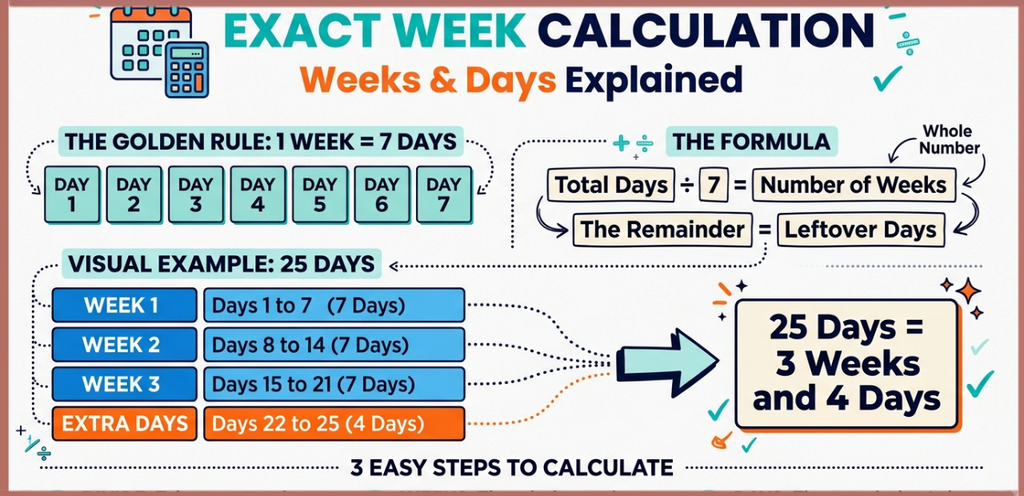
One common source of confusion is the difference between complete weeks and a decimal representation of time.
An exact week calculation begins with the elapsed number of days and divides that duration into seven-day periods. The remaining days are then reported separately or represented as a fraction of a week.
For example, suppose two dates are 45 days apart.
- 42 days represent six complete weeks.
- Three days remain.
- The total duration is six weeks and three days.
As a decimal, 45 divided by seven is approximately 6.43 weeks. Both descriptions represent the same duration, but the weeks-and-days format is often easier to understand in everyday planning.
Why Results May Differ Between Calculators
A week-counting tool might display 6.43 weeks, while another displays six weeks and three days. A calendar-focused tool might report the number of calendar weeks touched by the interval instead.
Before comparing results, check whether the tools are measuring elapsed time, complete weeks, fractional weeks, or calendar-week boundaries.
Also consider whether the start and end dates are counted inclusively. In ordinary date subtraction, the elapsed duration from Monday to the following Monday is seven days. If both endpoints are counted as included calendar dates, however, the list contains eight dates.
The calculation itself hasn’t become mysterious. The counting convention has simply changed.
Important Date Calculation Examples
Real examples make it easier to see how a Date Calculator can support different planning needs. Here are a few scenarios using ordinary calendar arithmetic.
Example: Add 20 Weeks
Suppose you have a project beginning on January 5, 2026, and you want to know its date after 20 weeks.
Twenty weeks equal 140 days. Adding 140 days to January 5, 2026, gives May 25, 2026.
This is useful for project milestones, study plans, and personal goals that are measured in fixed weekly periods.
Example: Add 7 Weeks
Imagine you begin a seven-week course on October 11, 2026. Adding 49 days gives November 29, 2026.
Because the interval is a whole number of weeks, the resulting date falls on the same day of the week as the starting date.
Example: Subtract 14 Weeks
If you have a deadline on December 1, 2022, subtracting 14 weeks means going backward by 98 days. The resulting date is August 25, 2022.
This can help you establish a start date for preparation, although you should always confirm whether your project needs calendar weeks, business weeks, or another convention.
Example: Find the Weeks Between Two Dates
Suppose a project starts on December 1, 2022, and ends on December 25, 2022. The elapsed difference is 24 days, which equals three weeks and three days.
This is a simple example of a Date Difference calculation. It also illustrates why reporting only whole weeks may hide part of the time interval.
Common Mistakes to Avoid When Counting Weeks
Even a straightforward week calculation can produce confusing results if the dates or counting method are entered incorrectly. Fortunately, most mistakes are easy to prevent.
Confusing Weeks With Months
Four weeks equal 28 days, but a calendar month can contain 28, 29, 30, or 31 days. Therefore, adding four weeks is not always the same as adding one calendar month.
If a task must happen exactly 28 days later, use a week-based calculation rather than a month-based estimate.
Entering Dates in the Wrong Format
Date formats vary by country. A date written as 04/05/2026 may mean April 5 or May 4, depending on the convention.
Whenever possible, use a clearly written date or a date picker. Confirm that the displayed starting date and ending date match your intention before calculating.
Forgetting Leap Years
Leap years add an extra day to February, which can affect date calculations spanning that month. A properly designed calculator accounts for this automatically, but manually counting days may introduce mistakes.
Ignoring Inclusive Counting
Some schedules count both the first and last dates, while others measure the elapsed time between them. This distinction can matter for attendance records, event schedules, and official deadlines.
If the result affects a formal commitment, confirm the applicable rule rather than relying on a generic week count.
Assuming Every Week Starts on the Same Day
Different calendars use different starting days for the week. This can affect calendar-week reports, although it does not change the fact that seven elapsed days make one week.
Being clear about your purpose will help you choose the appropriate calculation.
How to Choose a Free Online Weeks Calculator
A free weeks calculator should make date calculations easy to understand without requiring unnecessary steps. You don’t need a complicated interface for a simple question, but a few useful features can make a big difference.
Look for a tool that offers:
- Clear Start Date and End Date fields.
- Separate options for adding weeks, subtracting weeks, and comparing dates.
- Results displayed in weeks and remaining days.
- Automatic handling of month lengths and leap years.
- A convenient date picker and a visible calculation result.
- An option to reset the Input Fields and begin a new calculation.
- A clear explanation of elapsed weeks versus calendar weeks.
A Date & Time Calculator that includes several related calendar tools may be especially useful if you regularly plan appointments, deadlines, and recurring activities.
The best tool is not necessarily the one with the most buttons. It is the one that answers your question accurately and presents the result in a way you can use immediately.
Creative Ways to Use a Weeks Calculator in Everyday Life

A Weeks Calculator can do more than answer questions about dates. It can help turn long-term intentions into manageable steps, making plans feel less overwhelming.
Build a Weekly Planner
Suppose you want to read twelve books in twelve months. Instead of worrying about the whole year, divide the goal into weekly targets. A weekly planner lets you see what needs to happen now rather than focusing only on the distant finish line.
Use a calculator to determine milestone dates and create reminders for each stage. This approach works for exercise, reading, language learning, and many other habits.
Organize a Project Timeline
Large projects often become easier when divided into week-long phases. You might spend the first two weeks researching, the next four weeks building, and the final two weeks reviewing.
A week tracker can help you estimate milestones, compare planned and actual progress, and identify where more time may be needed.
Plan Family Events
Weddings, birthdays, holidays, and reunions all involve preparation. Counting backward from the event date can help you decide when to send invitations, arrange travel, or finalize important details.
It may seem like a small thing, but knowing that an event is eight weeks away gives you a more useful planning window than simply saying it is coming soon.
Track Personal Milestones
Perhaps you started a new job, began a course, or decided to save money for something meaningful. Measuring your progress in weeks can make consistency easier to recognize.
The goal isn’t to turn every part of life into a deadline. It’s to use time as a helpful guide while leaving room for the unexpected.
How to Make Date Calculations More Personal and Useful
Accurate calculations are only part of effective planning. The real benefit comes from connecting the result to something you care about.
If a calculator tells you that a milestone is twelve weeks away, write down what you hope to accomplish during those weeks. If it shows that an important event happened twenty weeks ago, reflect on what has changed since then.
You can also pair a date calculator with a notebook, digital calendar, or weekly planner. Add reminders for meaningful milestones, and review your progress at regular intervals rather than checking the calendar only when a deadline approaches.
For important medical, legal, financial, or contractual dates, confirm the relevant counting rules with an appropriate professional or official source. A calculator is excellent for arithmetic, but the rules governing a particular deadline may involve more than simple date subtraction.
Frequently Asked Question
week calculator from date
A week calculator from date helps you find the exact date by adding or subtracting a specific number of weeks from any chosen starting date. Simply enter the date and the number of weeks to get instant results.
20 weeks from today
The date 20 weeks from today is calculated by adding 20 calendar weeks to the current date. This is useful for planning events, appointments, deadlines, or future schedules.
no of weeks calculator
A no of weeks calculator determines the total number of weeks between two dates or calculates weeks from a selected date. It provides quick and accurate results in just a few clicks.
weeks calculator from date
A weeks calculator from date lets you calculate a future or past date by adding or subtracting weeks from a starting date. It is ideal for project planning, scheduling, and date tracking.
week counter
A week counter is a simple tool that counts the total number of weeks between two dates or from a specific date. It helps track time periods for work, school, pregnancy, and personal planning.
Read this blog https://brinleyo.com/what-is-3-months-from-today/
Conclusion: Make Every Week Count
Time has a funny way of slipping past us. One moment you’re writing down a new goal, and before you know it, several weeks have disappeared into ordinary routines, unexpected responsibilities, and little moments you didn’t think you’d remember.
A Weeks Calculator gives you a clearer way to understand that movement of time. Whether you need to calculate weeks between two dates, add weeks to a future milestone, subtract weeks from a deadline, or estimate a pregnancy timeline, the right tool makes the process faster and more reliable.
From simple calendar calculations to long-term project planning, week-based counting helps transform vague intentions into practical dates. You can see how much time has passed, how much remains, and where you might need to adjust your plans.
Remember to check your dates, understand the difference between elapsed weeks and calendar weeks, and choose a calculation that suits your purpose. Those small habits can save you from unnecessary confusion later on.
Most importantly, use the numbers to support your life rather than letting them control every moment of it. Some weeks will be wonderfully productive, others will feel slower, and a few may not go according to plan at all. That’s perfectly human.
If you’ve discovered a useful way to track time, plan a milestone, or use a week calculator in your daily routine, share your experience in the comments. Your approach might help someone else organize their plans with a little more confidence.
After all, a calendar tells us where the weeks fall, but what we choose to do with them is what makes those weeks meaningful.