Have you ever stood in your kitchen, recipe open, measuring cup in one hand and a kitchen scale in the other, wondering why something so tiny could feel oddly confusing? It happens more often than people admit.
One recipe quietly asks for 200 grams of flour, another cheerfully demands 1½ cups, and suddenly your peaceful baking afternoon starts feeling like a maths lesson that nobody invited you to. Funny thing is, it dosn’t have to be complicated at all.
Learning how to Convert grams to cups is less about memorizing numbers and more about understanding how ingredients behave.
Flour fluffs up, honey hugs the spoon, sugar settles neatly, and butter acts like it has its own personality. Every ingredient carries its own density, so one conversion never fits everything. That’s actually kinda fascinating when you stop rushing for a second.
Whether you’re baking cookies, preparing bread, making sauces, or simply adjusting a family recipe from another country, knowing how grams to cups conversions work saves time, reduces waste, and helps recipes turn out the way they were meant to.
| Conversion | Details |
|---|---|
| Tool | Convert Grams to Cups, g to Cups |
| Converts | Grams (g) ↔ Cups |
| Best For | Cooking & Baking |
| Depends On | Ingredient Density |
| Common Ingredients | Flour, Sugar, Butter, Water, Oil |
| Supports | Cups to Grams & Grams to Cups |
Why Grams and Cups Are Different
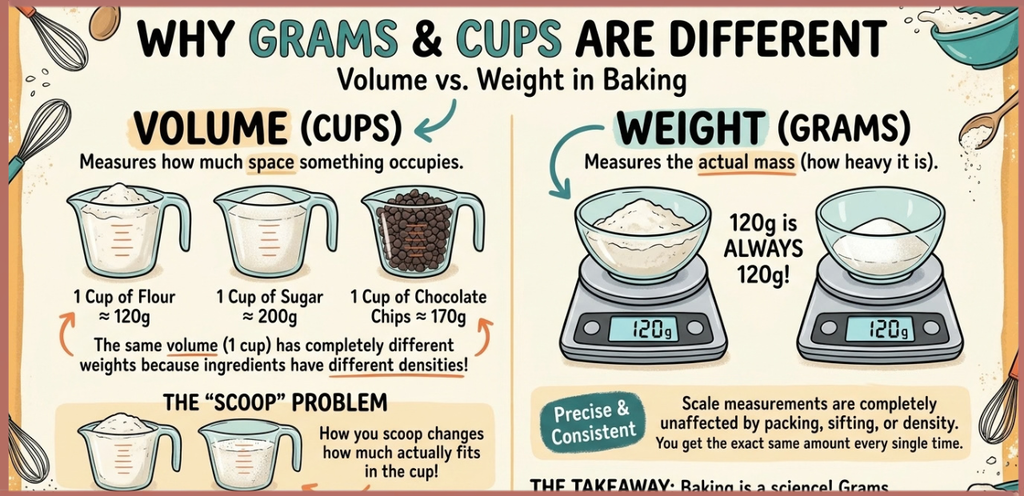
The biggest misunderstanding is believing grams and cups measure the same thing. They don’t.
Grams (g) measure mass or weight, while cups measure volume. Imagine filling a cup with feathers and another cup with stones. Both cups are full, but they certainly don’t weigh the same. Food works exactly like that.
Because ingredients have different density, converting between them always depends on what’s inside the cup.
For example:
- One cup of water weighs about 236 grams.
- One cup of flour weighs around 120 grams.
- One cup of honey weighs roughly 340 grams.
- One cup of butter weighs about 227 grams.
That little difference changes everything, honestly.
Understanding Ingredient Density
Density sounds like a scientific word that escaped a classroom, but in cooking it’s wonderfully practical.
Density simply tells us how much weight fits inside a certain volume.
Think about these ingredients:
- Water flows freely.
- Granulated sugar packs tighter.
- Powdered sugar traps lots of air.
- Cocoa powder can be fluffy or compressed.
- Brown sugar may be loosely packed or firmly packed.
That’s why a universal gram to cup converter cannot exist without asking which ingredient you’re converting.
The Basic Conversion Formula
The simplest conversion formula looks like this:
Cups = Grams ÷ Grams Per Cup
Or going the opposite direction:
Grams = Cups × Grams Per Cup
Everything depends on the ingredient’s grams per cup value.
For example:
- 240 g water ÷ 236 = approximately 1 cup
- 240 g flour ÷ 120 = approximately 2 cups
See how the same weight creates completely different cup measurements? Thats the secret.
Convert Grams to Cups for Common Ingredients
The easiest way to convert g to cups is by using an ingredient-specific chart.
| Ingredient | 100 g | 200 g | 250 g | 500 g |
|---|---|---|---|---|
| Water | 0.42 cup | 0.85 cup | 1.06 cups | 2.12 cups |
| Flour | 0.83 cup | 1.67 cups | 2.08 cups | 4.17 cups |
| Butter | 0.44 cup | 0.88 cup | 1.10 cups | 2.20 cups |
| Granulated Sugar | 0.50 cup | 1 cup | 1.25 cups | 2.50 cups |
| Brown Sugar | 0.45 cup | 0.91 cup | 1.14 cups | 2.27 cups |
This small grams to cups chart is one of the most useful references you can keep nearby while cooking.
Grams to Cups for Flour
When people search flour grams to cups, they’re usually preparing bread, pizza dough, cakes, or cookies.
One US cup of all-purpose flour weighs approximately 120 grams.
Common conversions include:
- 50 grams = 0.42 cup
- 100 grams = 0.83 cup
- 200 grams = 1.67 cups
- 250 grams = 2.08 cups
- 500 grams = 4.17 cups
Flour should always be spooned gently into the cup rather than scooped directly. Scooping compresses it, which changes the measurement a little bit more than you’d expect.
Sugar Grams to Cups
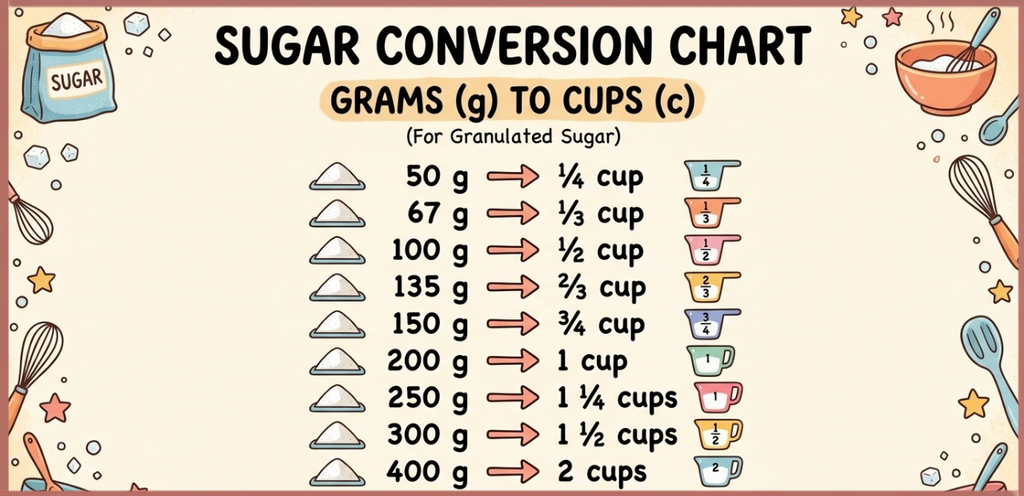
Different sugars behave differently.
Granulated sugar is heavier than powdered sugar but lighter than honey.
Approximate values:
- 100 grams = 0.5 cup
- 200 grams = 1 cup
- 250 grams = 1.25 cups
- 500 grams = 2.5 cups
For brown sugar, recipes sometimes specify packed or loosely packed measurements, which changes the final weight.
Butter Grams to Cups
Many international baking recipes list butter by weight.
Typical conversions include:
- 50 grams = 0.22 cup
- 100 grams = 0.44 cup
- 200 grams = 0.88 cup
- 250 grams = 1.1 cups
Softened butter and melted butter usually weigh the same, although measuring methods can slightly affect volume.
Water Grams to Cups
Water is one of the easiest ingredients because its density stays remarkably consistent.
Approximate values:
- 100 grams = 0.42 cup
- 200 grams = 0.85 cup
- 250 grams = 1.06 cups
- 500 grams = 2.12 cups
Many other liquids have similar densities, though oils differ slightly.
Honey Grams to Cups
Honey is much denser than water.
Approximate conversions:
- 100 grams = 0.29 cup
- 200 grams = 0.59 cup
- 250 grams = 0.74 cup
- 500 grams = 1.47 cups
If you’ve ever wondered why honey recipes feel heavier than expected, density is the answer.
Oil Grams to Cups
Whether using coconut oil, sunflower oil, or palm oil, oils have slightly lower density than water.
Most vegetable oils convert approximately like this:
- 100 grams = 0.46 cup
- 200 grams = 0.92 cup
- 250 grams = 1.15 cups
Always check the specific oil if precision matters.
Baking Ingredients That Need Careful Conversion
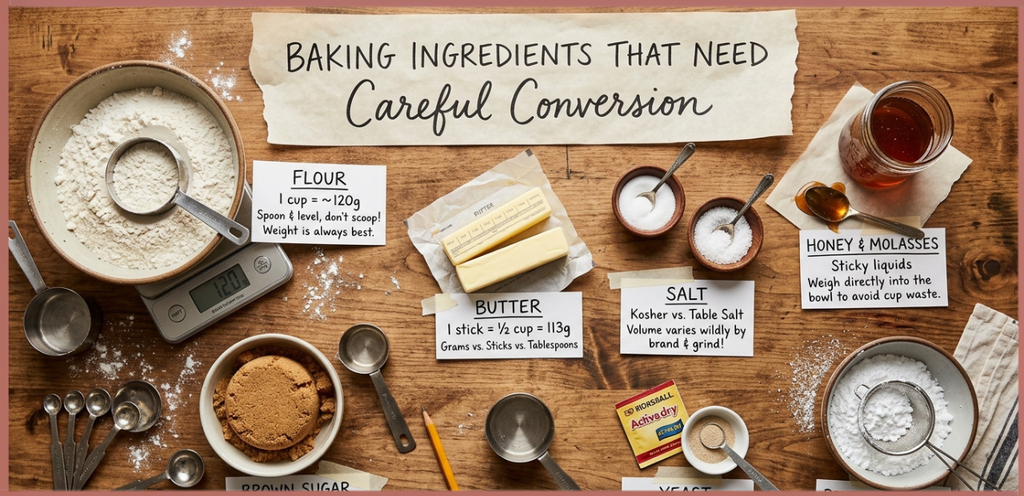
Some ingredients require extra attention because they’re light and airy.
These include:
- Baking powder
- Baking soda
- Cornstarch
- Cocoa powder
- Cinnamon powder
- Coffee powder
Even gentle tapping of the measuring cup changes volume slightly, so weighing these ingredients often produces better baking results.
Salt Conversions
Salt comes in different textures.
Examples include:
- Granulated salt
- Powdered salt
Fine salt weighs more per cup than coarse salt because smaller crystals fit closer together.
Recipes that simply say “salt” can sometimes produce slightly different results depending on which variety you choose.
Cups to Grams Conversion
Sometimes recipes move in the opposite direction.
Instead of Convert grams to cups, you might need cups to grams.
Examples:
| Ingredient | 1 Cup | 2 Cups |
|---|---|---|
| Water | 236 g | 472 g |
| Flour | 120 g | 240 g |
| Butter | 227 g | 454 g |
| Sugar | 200 g | 400 g |
| Honey | 340 g | 680 g |
Having both directions makes recipe scaling much easier.
US Cup, UK Cup, and Metric Cup
Not every cup measures the same amount.
The three most common standards are:
- US cup = 236.6 ml
- Metric cup = 250 ml
- UK recipes often use metric measurements today, though older recipes may vary.
When following recipes from another country, checking the cup standard prevents unexpected surprises.
Why Professional Bakers Prefer Grams
Professional kitchens almost always rely on weight conversion instead of cups.
Reasons include:
- Better consistency
- More accurate recipes
- Easier scaling
- Less cleanup
- Fewer measuring mistakes
A digital kitchen scale removes almost all guessing.
Kitchen Conversion Tips
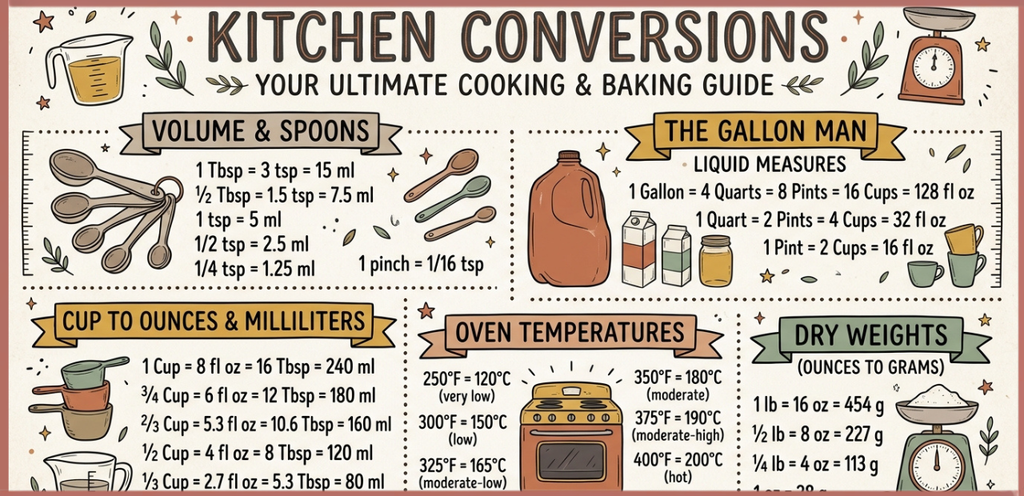
Here are a few habits that make cooking smoother:
- Use a digital scale whenever possible.
- Level dry ingredients with a straight edge.
- Measure liquids in transparent measuring cups.
- Check ingredient-specific charts instead of guessing.
- Remember that humidity can slightly affect flour.
Tiny details often create the biggest improvements.
Grams to Cups Calculator
An online grams to cups calculator or measurement calculator makes conversions almost instant.
Most tools ask you to:
- Choose the ingredient.
- Enter grams.
- View cups instantly.
Many calculators also work as a:
- cups to grams calculator
- grams to cups converter
- cups to grams converter
- recipe converter
- kitchen conversion calculator
- baking calculator
- cooking calculator
They’re especially useful when trying unfamiliar recipes from different countries.
Common Cooking Conversions
Here are several popular searches people make every day:
50 grams to cups
Depends on the ingredient. Flour is around 0.42 cup, while sugar is closer to 0.25 cup.
100 grams to cups
Flour equals about 0.83 cup, while water measures roughly 0.42 cup.
200 grams to cups
Water becomes about 0.85 cup, flour about 1.67 cups, and sugar about 1 cup.
250 grams to cups
This is one of the most searched conversions. Results vary depending on ingredient density.
500 grams to cups
Large baking batches often require this conversion, especially for bread or cake recipes.
Kitchen Measurement Guide
A reliable kitchen measurement guide should include:
- Measurement units
- Volume conversion
- Weight conversion
- Food measurement chart
- Ingredient density chart
- Cup measurement chart
- Gram conversion chart
- Cooking conversions
- Baking conversions
Keeping one nearby saves plenty of time during busy cooking sessions.
Why Recipes Sometimes Fail
People often blame ovens, pans, or ingredients.
Actually, measurement mistakes are among the biggest reasons recipes disappoint.
Using the wrong cup size.
Packing flour too tightly.
Guessing ingredient weights.
Confusing Milliliters (ml) with grams.
Mixing Liters (L), Cubic centimeters (cc), and volume without considering density.
Little errors quietly pile up until the final dish feels… not quite right.
Choosing the Right Measurement Tool

Today’s kitchens have several options:
- Measuring cups
- Digital kitchen scales
- Liquid measuring jugs
- Online converter tools
- Printable conversion table
- Mobile apps
Combining a scale with a reliable measurement conversion tool usually delivers the best accuracy.
Frequently Asked Question
230 g to cups
230 g equals different cup amounts depending on the ingredient. For water, it is about 0.97 US cups, while flour, sugar, and butter have different conversions due to density.
how many cups is 230 grams
How many cups 230 grams makes depends on what you’re measuring. Always use the correct ingredient conversion chart or calculator for the most accurate result.
390 grams to cups
390 grams converts to different cup values based on the ingredient’s density. For example, it is about 1.65 cups of water, but flour and sugar will have different measurements.
370 grams to cups
370 grams is approximately 1.56 cups of water, though the exact cup measurement varies for ingredients like flour, butter, cocoa powder, and sugar.
230g to cups
To convert 230g to cups, you need to know the ingredient being measured. A grams-to-cups converter provides the most accurate result by accounting for ingredient density.
Final Thoughts
Understanding how to Convert grams to cups isn’t really about memorizing endless numbers. It’s about knowing that ingredients behave differently because of their density, and respecting that difference while cooking. Once that simple idea clicks, recipes become less stressful and much more enjoyable.
Whether you’re converting g to cups, switching cups to grams, using a gram to cup converter, or checking a grams to cups chart, accuracy helps every recipe shine.
From Water, Flour, Butter, Honey, Cornstarch, Coffee powder, Baking powder, and Granulated sugar to Cocoa powder, every ingredient has its own story hidden inside the measuring cup.
Keep a trusted food measurement guide, use a digital scale whenever possible, and don’t be afraid to double-check conversions.
Before long, those once-confusing recipe measurements will feel surprisingly natural, and your baking might even become the thing friends quietly ask you about again and again.