There is something oddly satisfying about looking at a date today and wondering where it will land years into the future. Maybe you are planning an anniversary, checking a contract deadline, imagining a long-term project, or simply asking yourself, “What date will it be in 10 years?”
It sounds like an easy question, but calendars have their little traps, and doing the math in your head can get messy pretty quick.A Years From Now Calculator makes this kind of date computation much easier.
Instead of counting through calendars, remembering leap years, or second-guessing whether the final date falls on a particular weekday, an online tool can perform the calculation in moments. You enter a current date, choose the number of years, and the output gives you the resulting future date.
The idea is simple, but the usefulness goes much further than simple calendar math. A good calculator can help with anniversaries, birthdays, project milestones, long-term schedules, school plans, financial dates, and all those “years later” questions that suddenly appear when you are trying to organize real life.
| Years From Now | Result |
|---|---|
| 1 year | 2027 |
| 3 years | 2029 |
| 5 years | 2031 |
| 10 years | 2036 |
| 20 years | 2046 |
What Is a Years From Now Calculator?
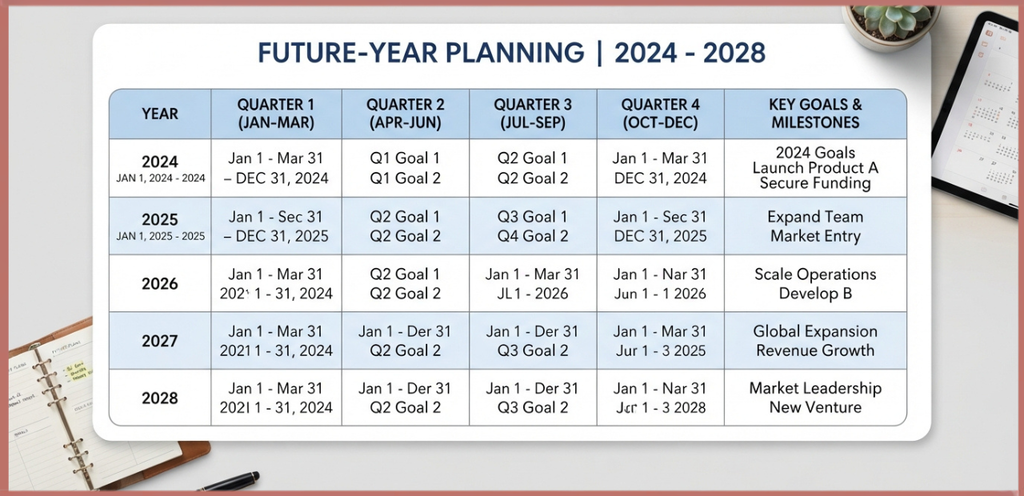
A Years From Now Calculator is an online calculator designed to determine a date a certain number of years before or after another date.
In the most common situation, that starting point is today, which is why you may also see it described as a Years From Today Calculator.
For example, if someone asks what date will occur five years from today, the calculator starts with today’s date and performs year addition.
It then displays the corresponding future date, often along with additional calendar details such as the month, day, year, and sometimes the Day of the week.
This is different from simply adding a fixed number of days. A year is connected to the calendar, and leap years mean that the number of days between two dates can vary. That tiny detail is exactly where casual mental math can wander off the road a little.
Why Use a Years From Now Calculator Instead of Counting Manually?
Counting years by hand seems harmless when the number is small. One year, two years, maybe three years—you can usually figure it out without reaching for a tool. But once you start asking about 20, 30, or 50 years, manually checking each Calendar becomes unnecessarily annoying.
A future date calculator handles the calendar rules for you. You do not need to flip through pages, check every February, or wonder whether a particular date changes because of a leap year.
It is especially useful when accuracy matters. If you are working with an anniversary, a legal or business schedule, an academic plan, or an important personal milestone, getting the exact date is much better than having a date that is “probably right.”
Another benefit is speed. A date calculator can produce date results almost instantly, while manual calculation can take longer than expected, especially when several future dates need to be checked.
How the Years From Now Calculator Works
The basic process is refreshingly uncomplicated. First, you provide the starting date. This can be today’s date or another date you choose. Then you enter the Number of years you want to move forward.
For instance, if the starting date is September 12, 2026, and you want to know the date five years later, the calculator adds five calendar years to that starting point.
The Input field may ask for a date, a number of years, or both. After you submit the input, the Output generally presents the future date and may include the corresponding weekday or other calendar information.
So, in plain language:
- Choose the starting Date.
- Enter the number of Years.
- Select whether you want to move forward or backward, if the tool offers that option.
- Run the Calculation.
- Read the resulting date results.
No dramatic calendar adventure required.
Years From Today Calculator: Starting With Today’s Date
A Years From Today Calculator is particularly handy when the starting point is simply today. Instead of entering a date manually, some tools automatically use the Current date as the starting point.
As of September 12, 2026, which is a Saturday, asking “what date is 1 year from today?” gives September 12, 2027. Asking “what date is 2 years from today?” gives September 12, 2028, and so on.
The useful thing here is that you can immediately experiment with different time horizons. You might check 5 years from today, then 7 years from now, then 10 years from today, without doing separate calendar calculations yourself.
This makes the calculator useful for questions such as:
- What date is 1 year from today?
- What date is 2 years from today?
- What date is 3 years from now?
- What date will it be in 5 years?
- What day will it be in 10 years?
- What date will it be 20 years from today?
- What date will it be 25 years from today?
- What date will it be 30 years from today?
- What date will it be 40 years from today?
- What date will it be 50 years from today?
These questions may look almost identical, but the calculator lets you explore them without repeatedly doing the calendar math.
Years From Now Calculator for Long-Term Planning

Long-term planning has a strange quality: ten years sounds impossibly far away until you suddenly need an exact date ten years from now. Then it becomes surprisingly important.
A Years From Now Calculator can support long-range planning by turning vague statements such as “five years later” into a precise calendar date.
Imagine a business planning a five-year strategy. The phrase “five years from now” is useful for conversation, but a project manager may eventually need an actual date for a milestone. The calculator converts that broad duration into a specific day.
The same thing happens with personal planning. An anniversary date, recurring family event, educational milestone, property agreement, or long-term goal may all benefit from knowing the exact calendar point ahead.
Seven practical long-term examples
- 5 years from today useful for medium-term personal or professional milestones.
- 7 years from now helpful when planning a longer educational or career timeline.
- 10 years from today useful for long-range financial and project planning.
- 20 years from today helpful for imagining distant milestones and future schedules.
- 25 years from today useful for major anniversary planning.
- 30 years from today suitable for very long-term timelines.
- 50 years from today useful when exploring a distant historical or family milestone.
The point isn’t that every person needs to calculate fifty years ahead. Sometimes curiosity is reason enough, and honestly, calendars are fun when you let them be.
Understanding the Exact Date After Adding Years
When people search for date after X years, they often want more than a rough estimate. They want the exact date after years.
If you begin with September 12, 2026 and add ten calendar years, the resulting date is September 12, 2036. The month and day remain the same because the starting date has a valid corresponding date in the destination year.
The situation becomes more interesting around dates such as February 29. Leap years require careful treatment because February 29 does not appear in every year. A reliable calculator needs to apply appropriate calendar rules instead of blindly treating every year as exactly 365 days.
This is why date calculation and simple arithmetic are not always the same thing. Calendar-based year addition respects the structure of the calendar itself.
Years From Now and Leap Years
Leap years are one of the main reasons a proper calendar calculation is preferable to simply multiplying the number of years by 365 days.
Most years contain 365 days, while leap years contain 366. That extra day can affect the total number of days between two dates even though the year-to-year date may appear straightforward.
For example, a calculator may show a start date, a future date, and the total number of days separating them. The result can therefore differ from a rough calculation based on 365 days per year.
This matters when a user needs Total days, Total weeks, or a precise duration rather than only the final date. A Duration calculator may be better for some of those questions, while a years calculator is ideal when the goal is specifically to add calendar years.
Date and Time: Does the Time Matter?
For many simple year calculations, the Date and time distinction is not important. If you only want to know which calendar date occurs five years after a given date, the date itself is normally enough.
However, things become more complicated when a calculation includes an exact time of day. A future time calculation may need to consider timezones, daylight-saving changes, and the location associated with the original timestamp.
That is where Timezone converters and dedicated time tools become useful. A years calculator is primarily concerned with calendar dates, while more specialized tools may handle hours, minutes, seconds, and time-zone changes.
So, if your question is “what date is ten years from today?”, a date calculator is usually the right tool. If your question is “what exact date and time will this event occur in another timezone ten years from now?”, you may need a combination of calendar and time calculation tools.
Years From Now Calculator for Anniversaries and Important Dates
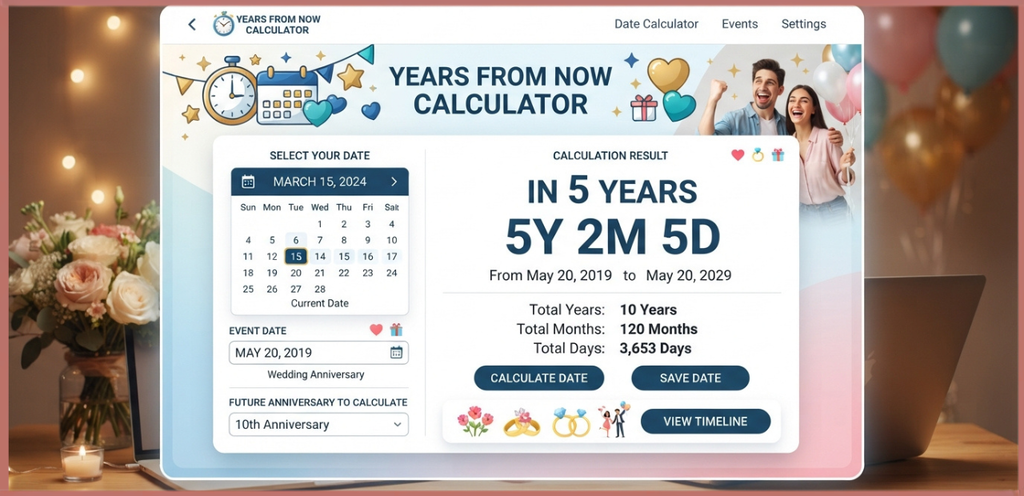
Anniversaries are one of the easiest places to see why exact dates matter. Saying “our tenth anniversary is sometime next year” feels incomplete when you actually need to mark the occasion.
An anniversary date calculator can help turn the original event date into future anniversary dates. A Years From Now Calculator can perform the year addition, making it easier to identify the date for the first, fifth, tenth, twenty-fifth, or even fiftieth anniversary.
It can also help when planning invitations or scheduling reminders. Once the exact future date is known, you can add it to a digital calendar and begin planning without relying on memory.
Ten situations where exact future dates can help
- Anniversary planning
- Birthday milestone planning
- School and graduation timelines
- Long-term project milestones
- Contract review dates
- Membership renewal planning
- Business strategy timelines
- Family event planning
- Historical date comparisons
- Personal goal timelines
These uses are simple, but they show why a small online tool can become surprisingly useful in ordinary life.
Years From Today: Examples You Can Calculate
Sometimes the easiest way to understand a calculator is to see the kinds of questions people actually type into it.
Suppose the starting point is September 12, 2026. A person may ask what date will arrive one year later, while another may be thinking much farther ahead.
Here are several example questions a Years From Today Calculator can answer:
- What date is 1 year from today? September 12, 2027.
- What date is 2 years from today? September 12, 2028.
- What date is 3 years from now? September 12, 2029.
- What date will it be in 5 years? September 12, 2031.
- What date is 7 years from now? September 12, 2033.
- What date is 10 years from today? September 12, 2036.
- What date is 20 years from today? September 12, 2046.
- What date is 25 years from today? September 12, 2051.
- What date is 30 years from today? September 12, 2056.
- What date is 50 years from today? September 12, 2076.
These examples assume standard calendar-year addition from the stated starting date. If you use a calculator on another day, the starting point naturally changes to your local date.
What About Weeks, Days, and Months?
A useful date calculator may provide more than just the final year and date. Some tools also show the duration between the original date and the result in Months, Total weeks, or Total days.
These values should be understood as different measurements of the same period. A year-based result tells you the calendar relationship, while a total-days result tells you the exact elapsed-day distance between two dates.
For example, a period described as 37 weeks is not automatically identical to “nine months” or “one year.” Months have different lengths, and years can contain either 365 or 366 days.
If you specifically need elapsed time, a date duration calculator or Duration calculators may give a more appropriate result. If you need the date reached after adding years, a years calculator is the cleaner choice.
Years From Now Calculator vs. Other Date Tools
There are several kinds of date tools online, and their names can overlap a little. That can make searching confusing.
A Date calculator is a broad term covering calculations involving dates. A Future date calculator usually focuses on finding a date ahead of the starting point. A Calendar calculator may provide broader calendar-related computations.
A years calculator specifically emphasizes adding or subtracting years. Meanwhile, a years difference calculator is normally designed to determine how many years separate two existing dates.
A date finder can help locate a particular date, while an online date calculator may combine several types of date arithmetic in one interface.
Knowing the difference saves time because you can choose the tool based on the actual question rather than trying random calculators until something looks right.
A Simple Date Table for Future-Year Planning
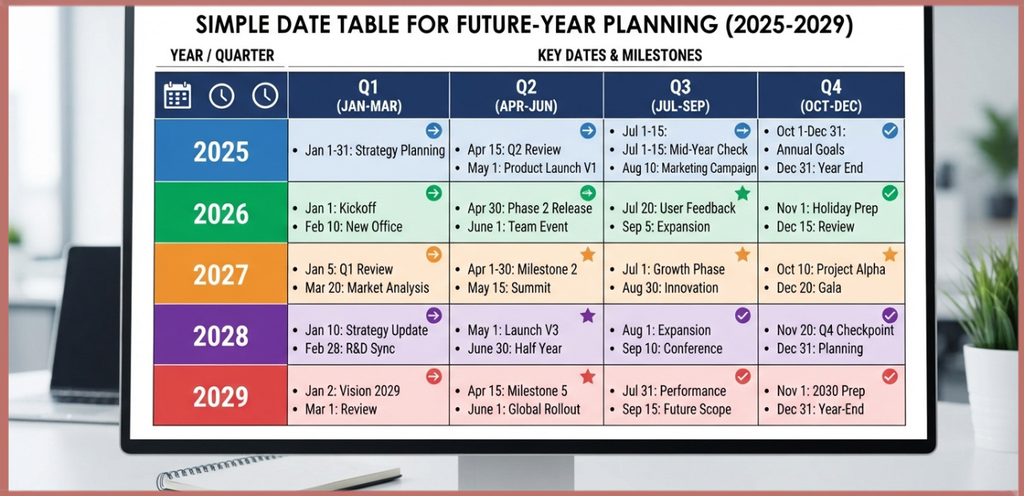
A Calendar table can make future planning easier when several dates need to be reviewed together. Starting from September 12, 2026, a simple year timeline could look like this:
| Years Ahead | Future Date | Year |
|---|---|---|
| 1 year | September 12, 2027 | 2027 |
| 2 years | September 12, 2028 | 2028 |
| 3 years | September 12, 2029 | 2029 |
| 5 years | September 12, 2031 | 2031 |
| 7 years | September 12, 2033 | 2033 |
| 10 years | September 12, 2036 | 2036 |
| 20 years | September 12, 2046 | 2046 |
| 25 years | September 12, 2051 | 2051 |
| 30 years | September 12, 2056 | 2056 |
| 50 years | September 12, 2076 | 2076 |
The Day of the week can be calculated separately or displayed by a more detailed calculator. That can be useful when an event needs to happen on a specific weekday, especially for scheduling.
Common Mistakes When Calculating Years Ahead
One common mistake is assuming every year equals exactly 365 days. That approach may work for a rough estimate, but it can produce the wrong result when leap years fall inside the period.
Another mistake is confusing “adding years” with “adding a fixed number of days.” These are related, but they are not always interchangeable. Calendar math follows calendar dates, while day-based duration calculations count elapsed days.
People also sometimes forget the starting point. “Ten years from now” means ten years from the date you are using today, not necessarily ten years from January 1 of the current year.
Finally, timezone differences can cause confusion when a date is connected to a specific time. If the calculation crosses regions, check the Local date and use appropriate timezone tools when needed.
How to Get the Most Accurate Results
For the cleanest result, enter the starting date carefully and make sure the number of years is correct. A small input mistake naturally creates a different output, even when the calculator itself is working perfectly.
If your tool provides additional Calendar details, check them rather than looking only at the large final date. Seeing the weekday, month, year, and duration can help catch misunderstandings.
For especially important dates, it is also sensible to verify the result with another trusted calendar or date tool. Technology is helpful, but checking an important anniversary or deadline twice isn’t exactly a bad habit.
Years Into the Future Can Feel Surprisingly Real
There is a funny emotional side to calendar calculations. When you ask about one year from now, the future feels close. Ask about ten years, and suddenly the date feels almost fictional.
A years timeline makes distant dates easier to imagine. You can see how a simple starting date stretches across five, ten, twenty, or fifty years, each point becoming a little marker in the future calendar.
That can be useful for planning, but it can also be a gentle reminder that dates are more than numbers. A future date may represent a goal, a celebration, a deadline, a reunion, or simply a moment someone wants to remember.
How to Use a Years From Now Calculator for Event Planning
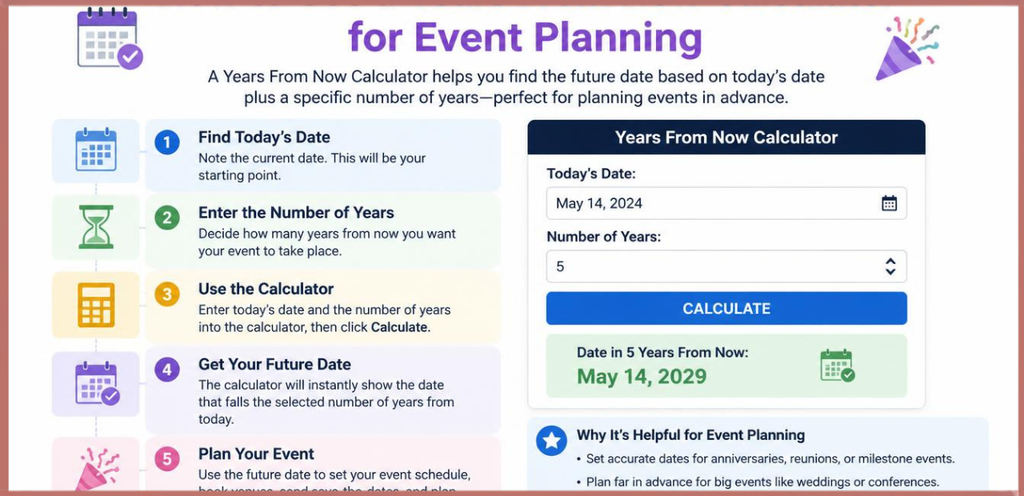
For event planning, start with the original date associated with the event. Then determine how many years ahead you need to look.
For an anniversary, for example, enter the original date and add the desired number of years. For a recurring long-term milestone, calculate several future dates and place them into your calendar.
This approach can be particularly useful when planning events far in advance. Instead of saying “we will deal with it several years later,” you have a concrete future schedule calculator result to work with.
It turns a fuzzy future into an actual calendar appointment, which is kind of the whole charm of these tools.
Frequently Asked Questions About Years From Now Calculators
What is a Years From Now Calculator used for?
A Years From Now Calculator is used to find a future date by adding a selected number of calendar years to a starting date. It can help with anniversaries, milestones, schedules, planning, and general date lookup.
What is the difference between a Years From Now Calculator and a Years From Today Calculator?
The terms are often used almost interchangeably. A Years From Today Calculator normally starts with today’s date automatically, while a general years calculator may allow you to choose any starting date.
What date will it be in 5 years?
If the starting date is September 12, 2026, five calendar years later is September 12, 2031. The exact answer changes whenever the starting date changes.
What date is 10 years from today?
From September 12, 2026, ten years from today is September 12, 2036. A calculator can also provide related calendar information if the tool supports it.
Can I calculate 25 years from today?
Yes. A years calculator can add 25 calendar years to the current date and return the resulting future date. This is useful for long-term anniversaries, milestones, and planning.
Does a years calculator account for leap years?
A proper calendar-based calculator should account for leap-year rules when determining the resulting date or elapsed duration. This is one reason it can be more reliable than simply multiplying years by 365 days.
Can I use a years calculator for dates in the past?
Many tools allow both forward and backward calculations. You can subtract years from a selected date to determine an earlier date, depending on the calculator’s available options.
Does the calculator show the day of the week?
Some do. If weekday information is included in the Output, you may see whether the resulting date falls on Monday, Tuesday, Saturday, or another day.
A Practical Way to Think About Future Dates
The easiest way to understand year-based date calculation is to think in terms of a calendar rather than a stopwatch. You are moving from one calendar date to the corresponding date a certain number of years ahead.
So, if the starting point is September 12, 2026, adding ten years means moving to September 12, 2036. The calculator performs this date prediction without requiring you to manually inspect ten different calendars.
If you instead need to know the exact number of days between those dates, then a day-based duration tool is more suitable. Different questions deserve different calculations, and that’s where choosing the right calculator becomes useful.
Frequently Asked Question
18 years from now
Eighteen years from now is the exact future date that falls 18 calendar years after today. A Years From Now Calculator makes this calculation quick and accurate.
4 years from today
Four years from today gives you the exact calendar date and day of the week after adding four years to the current date. It is useful for long-term planning and anniversaries.
what year will it be in 5 years
Five years from now will be five calendar years ahead of the current year. A Years From Today Calculator instantly shows both the future year and the exact date.
8 years from today
Eight years from today calculates the precise future date by adding eight years to today’s date. This is helpful for scheduling future milestones and important events.
3 years from now
Three years from now refers to the exact date that occurs three calendar years after today. An online Future Date Calculator provides the result in seconds.
Conclusion: Let the Calendar Do the Counting
A Years From Now Calculator takes a question that sounds simple and makes the answer precise. Whether you’re wondering about what date is 1 year from today, planning 5 years from today,
checking 10 years from today, or looking at a date after 25 or 50 years, the same basic idea applies: start with a date, add the desired number of years, and read the result.
The real value is not just speed. It is confidence. Leap years, varying month lengths, weekday changes, and long stretches of calendar time are easy to overlook when calculating manually.
A dependable online date calculator handles that calendar computation so you can spend your attention on why the date matters.
And perhaps that is the nicest part of looking years ahead. A date on a screen might seem like just numbers, but behind it could be an anniversary, a personal goal, a major project, a family celebration, or a future moment you are quietly looking forward to. The future calendar gives that moment a place to exist.
So enter the Current date, choose your Number of years, and let the calculator uncover the exact future date. Sometimes knowing when something will happen is the first small step toward actually making plans for it.