There are moments in life when a single date somehow carries a whole suitcase of feelings with it. A due date, a wedding anniversary, the day school begins, a project deadline, or simply the date when you promised yourself that you would finally start something important.
In all these little situations, knowing the exact number of weeks can make time feel much easier to understand. This is where a Weeks Calculator becomes surprisingly handy, even though at first glance it sounds like one of those very plain tools nobody thinks much about.
Imagine a family waiting for a baby girl. They may count the weeks of pregnancy, mark appointments on a calendar, plan a baby shower, prepare a nursery, and quietly wonder how quickly the tiny person they haven’t met yet will arrive.
Someone might say, “Only eight weeks left,” while another person checks the calendar again because, well, nobody trusts their mental maths at 11 p.m. A simple week calculator can turn those scattered dates into a clear time interval.
The same idea works far beyond pregnancy. Students use dates to organise semesters, businesses use them for deadlines, travellers use them for trip planning, and families use them to remember anniversaries or upcoming celebrations. A date calculator doesn’t make time move differently, of course, but it can make the passing of time a lot less confusing.
Weeks Calculator Short Table
| Feature | Details |
|---|---|
| Tool Name | Weeks Calculator |
| Purpose | Calculate the number of weeks between two dates. |
| Add Weeks | Find a future date by adding weeks. |
| Subtract Weeks | Find a past date by subtracting weeks. |
| Input | Start date and end date or number of weeks. |
| Output | Total weeks, days, and resulting date. |
| Common Uses | Project planning, pregnancy tracking, event scheduling, and date calculations. |
What Is a Weeks Calculator?
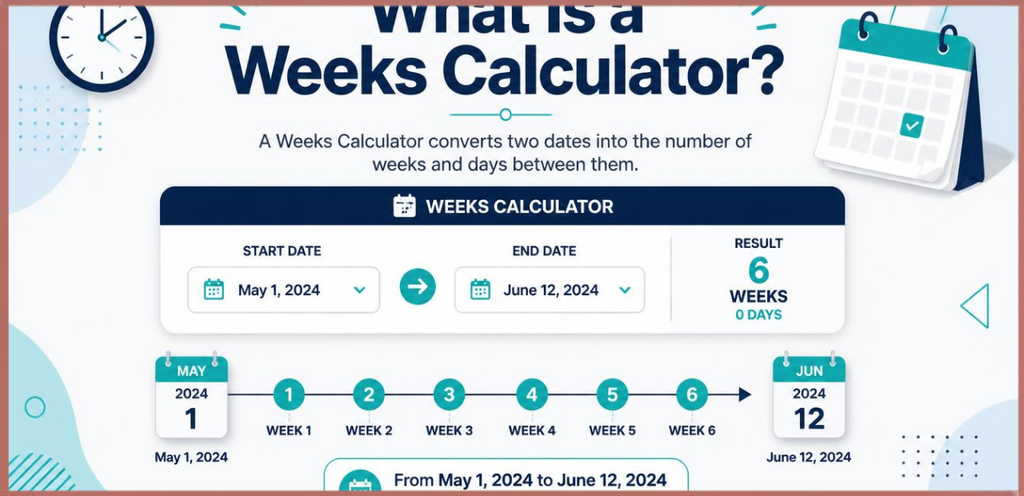
A Weeks Calculator is a practical online tool that helps you work with dates and periods measured in weeks. Depending on the calculator, you may be able to find the number of weeks between dates, add a certain number of weeks to a date, or subtract weeks from a particular day.
The basic idea sounds almost too simple: give the calculator a date, provide another date or a number of weeks, and let it perform the date calculation.
Yet this simplicity is exactly why people use these tools. Calendar arithmetic becomes surprisingly annoying when months have different lengths and leap years sneak into the equation like they own the place.
For example, if you want to know how many weeks are between a Start Date and an End Date, the calculator measures the difference between those dates.
Some tools show a result entirely in weeks, while others provide a combination such as weeks and remaining days. That can be much more useful when the dates don’t fall neatly seven days apart.
A good calculator may include several functions, such as Weeks Between, Add Weeks, and Subtract Weeks. These three options cover a large part of what people usually want when searching for a weeks between dates calculator.
Why Calculate Weeks Instead of Just Counting Days?
Days are familiar, but weeks can sometimes tell the story of a period more naturally. A school term, pregnancy milestone, training plan, vacation countdown, or work sprint is often easier to describe in weeks than in an awkward pile of days.
Suppose someone tells you that an event is 84 days away. Technically, that is perfectly clear, but “12 weeks away” may feel more immediately understandable.
This is one reason people search for tools to calculate number of weeks rather than simply asking for a raw date difference.
Weeks also provide a useful middle ground. Months are convenient, but they don’t all contain the same number of days.
Days are precise, but they can make longer periods feel unnecessarily large. Weeks sit somewhere in between, giving you a consistent seven-day unit for measuring duration.
This becomes particularly meaningful for families preparing for a newborn. A parent might not think, “There are 63 days remaining.”
They are more likely to say, “We have about nine weeks to get everything ready.” Somehow, that sounds both manageable and terrifying at the same time.
Weeks Between Dates: How the Calculation Works
The Weeks Between Dates function is probably the most familiar part of a weeks calculator. You enter a Start Date and an End Date, and the calculator determines the length of the interval.
At its simplest, the process involves finding the number of days between the two dates and dividing that number by seven. If the result divides evenly, you have a whole number of weeks. If it doesn’t, the remaining days can be displayed separately.
For example, suppose you enter December 1, 2022 as the starting date and December 25, 2024 as the ending date.
The calculator examines the complete calendar interval rather than guessing based on the number of months involved. This matters because calendar months don’t politely agree to contain the same number of days.
A similar example can be useful when planning a future event. If your reference date is October 2, 2026, and your target date is February 26, 2027, you can use a date difference calculator to determine the exact duration.
Searching manually might produce a result that is nearly right, but “nearly right” isn’t very comforting when you’re arranging flights, appointments, or an important family celebration.
How Many Weeks Between Two Dates?
People often search the internet with a wonderfully direct question: how many weeks between two dates? The answer depends completely on which two dates you’re comparing.
To find the number of weeks between dates, enter the earlier date as the Start Date and the later one as the End Date. The tool then calculates the elapsed duration.
Some calculators also allow the dates in reverse order, although the displayed result may depend on how that particular tool handles negative intervals.
For example, if you want to know how many weeks between October 2 2026 and February 26 2027, a weeks calculator can determine the exact interval without requiring you to flip through several months of a wall calendar.
This can be useful for everything from personal milestones to professional schedules. You might be checking how long you’ve been following a fitness plan, how many weeks remain until a vacation, or how much time has passed since a child was born. Sometimes the answer is just a number, but sometimes that number makes a milestone suddenly feel real.
Add Weeks to a Date
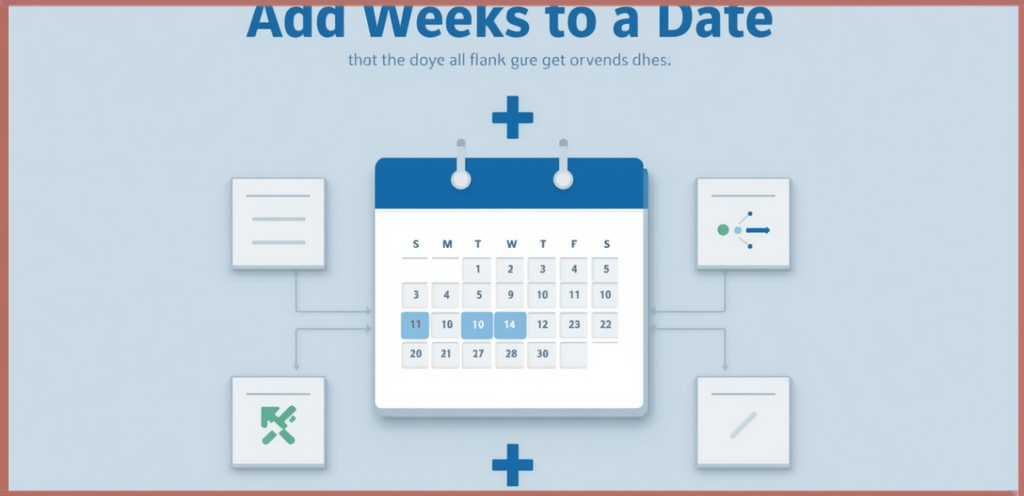
The Add Weeks function works in the opposite direction from calculating an interval. Instead of asking how long two dates are apart, you start with one date and move forward by a specified number of weeks.
For instance, if your starting date is October 2, 2026, and you want to add 7 weeks, the calculator gives you the resulting future date.
This is useful when scheduling follow-ups, planning project stages, creating study plans, or figuring out when a recurring milestone will arrive.
The beauty of adding weeks is that every week contains exactly seven days. You don’t have to worry whether the next month has 28, 30, or 31 days.
Just tell the calculator the starting point and the number of weeks, and the date addition becomes straightforward.
A parent might use this when organising a series of baby-related preparations. Seven weeks from one appointment, four weeks from another, or ten weeks until a planned family gathering can all be worked out without turning the kitchen table into a battlefield of calendars and pens.
Subtract Weeks From a Date
Sometimes you need to travel backward through time instead of forward. That’s where Subtract Weeks becomes useful.
If you have a reference date and want to know what happened 14 weeks earlier, use the subtract weeks from date function. For example, selecting a date and choosing subtract 14 weeks will provide the corresponding past date.
This can be useful for reviewing project history, finding the approximate date of an earlier event, organising records, or working backward from a deadline.
A past date calculator is particularly helpful when the target date is several months away because counting backward across different months is much less pleasant than it sounds.
It can also answer everyday questions such as “What date was 7 weeks ago?” or “When did this 12-week period begin?” These aren’t complicated questions, but they’re exactly the sort of questions where our brains suddenly decide to take an unscheduled holiday.
Weeks From Now and Weeks Ago
The phrases weeks from now and weeks ago are common ways people think about time. Instead of starting with two known calendar dates, you’re starting with today and moving forward or backward.
To calculate weeks from now, choose today’s date as the base date, then add the desired number of weeks. To calculate weeks ago, take today’s date and subtract the number of weeks.
This can be handy for planning future dates, reminders, subscriptions, travel, school activities, or personal goals. If you want to know what date falls 12 weeks from today, a future date calculator can provide the answer almost instantly.
It also works beautifully for looking backward. Perhaps a photograph was taken “about eight weeks ago,” but you want the actual date. A week difference calculator can help turn that casual memory into a precise calendar date.
Using a Weeks Calculator for Pregnancy and Baby Planning
Pregnancy is one of the most meaningful situations in which people naturally think in weeks. The arrival of a baby girl can transform an ordinary calendar into something emotional: every week suddenly represents another step toward meeting someone who has not even introduced herself yet.
Parents may use a weeks calculator to understand intervals between appointments, estimate dates, organise preparation tasks, or simply keep track of milestones.
It can help convert a date range into weeks and days, which may be easier to understand when preparing for the baby’s arrival.
For families welcoming a daughter, the calculations are only one small part of the preparation. There are clothes folded far too early, names debated over dinner, relatives sending advice nobody requested, and that one tiny pair of socks that somehow becomes everyone’s favourite object.
The numbers may say “21 weeks,” but emotionally that number can contain an enormous amount of anticipation. A calculator gives you the mathematical answer; the family gives that answer its meaning.
When a Date Calculator Makes Everyday Life Easier
There are many ordinary situations where a date range calculator saves time. Consider a person planning a six-week course, a manager organising a twelve-week project, or someone trying to determine how long they have been following a new routine.
You can use a time interval calculator to compare two dates, measure elapsed time, and understand a particular period.
It is especially useful when the interval crosses months or years because those calendar boundaries are where mental counting starts becoming unreliable.
Another advantage is consistency. Two people manually counting dates may occasionally arrive at different answers because one includes the starting day and the other doesn’t. A calculator follows a defined method, making the result easier to reproduce.
That little bit of consistency matters when the dates are being used for schedules, records, deadlines, or other practical purposes. Nobody wants an important meeting delayed because three people counted the weeks three different ways.
Understanding Weeks and Days Together
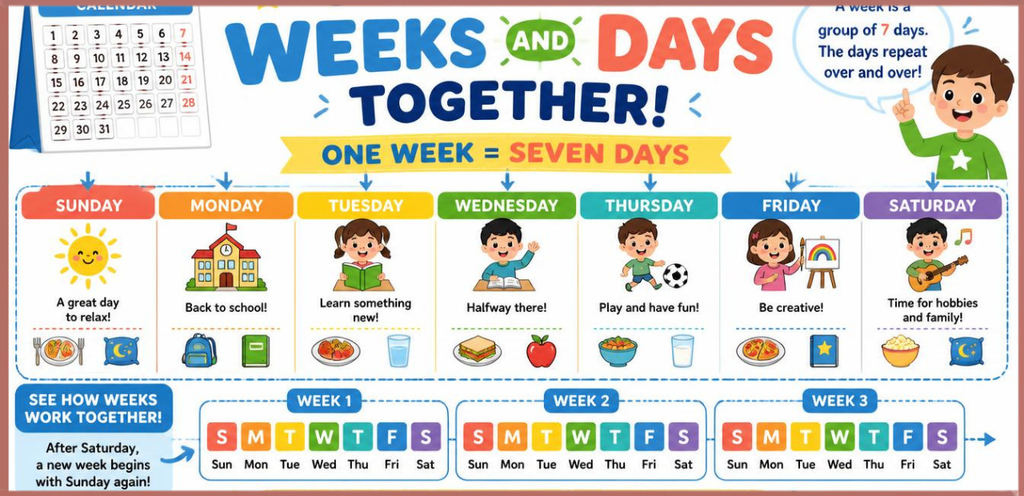
Not every date range produces a neat number of weeks. Sometimes the result is something like 21 weeks and 3 days. That’s not a problem; in fact, it can be more informative.
If the total number of days is 150, for example, dividing by seven gives 21 complete weeks with 3 days left over. A useful weeks between dates calculator may show both values so that you don’t have to perform the conversion yourself.
This format is especially helpful for longer intervals where precision matters. Saying “21 weeks” can suggest exactly 147 days, while “21 weeks and 3 days” communicates the complete duration.
The distinction becomes important when you are tracking something that depends on exact timing. In such cases, don’t casually round a date interval unless you know that approximation is acceptable. Calendars, annoyingly enough, do not care that a rounded answer looks prettier.
A Few Real Life Examples of Using a Weeks Calculator
Imagine you’re organising a family reunion. The event is scheduled for February 26, 2027, and today is October 2, 2026. Instead of repeatedly checking the calendar, you can use a calculate weeks between dates function to understand how much preparation time remains.
Or perhaps you’re starting a 10 week learning program on a Monday. With an add weeks calculator, you can calculate the date when the program reaches its final week. This makes planning assignments, reviews, and celebrations much easier.
Someone else might be reviewing an old photograph and wondering when it was taken. If they know the picture was captured approximately 14 weeks before a known event, a subtract weeks calculator can work backward from that event to find the likely date.
Even something as ordinary as planning a holiday can benefit from a date interval calculator. When several bookings, reservations, and appointments are involved, having the exact duration between dates prevents those small calendar mistakes that become expensive later.
Cultural Moments, Family Milestones, and Counting Time
Different cultures mark the arrival of a baby in different ways, but the emotional thread is often remarkably similar. Families may gather for naming ceremonies, prayers, meals, blessings, photographs, gifts, or quiet visits after the mother and baby return home.
In many households, the arrival of a daughter isn’t treated as merely another date on the calendar. Grandparents may remember the exact day for decades, sometimes even recalling the weather or what they were eating when they heard the news. A date becomes a family story.
That is why tools like a Weeks Calculator can have a surprisingly human side. The calculator itself only performs a date calculation, but the dates being calculated may represent waiting, recovery, preparation, celebration, or remembrance.
A number such as 21 weeks has no emotion on its own. Give that number a family waiting to meet a baby, however, and suddenly it means something rather different.
Tips for Getting Accurate Results
Before using any weeks calculator online, make sure you enter the dates carefully. A simple month or day mistake can completely change the result, and calendars are not especially forgiving about misplaced numbers.
Check whether the calculator asks for a Start Date, End Date, or a number of weeks. If you’re using an Add Weeks or Subtract Weeks function, confirm that you’ve selected the correct Operation Type before pressing the Calculate button.
Some tools also include a Clear button. It sounds unimportant, but it is useful when you’re doing several calculations and don’t want old input fields hanging around like unwanted guests.
If you are calculating an important date for medical, legal, financial, or official purposes, use the calculator as a convenience rather than the sole authority. Official schedules and professional guidance may use their own conventions for counting dates.
How to Calculate Weeks Manually
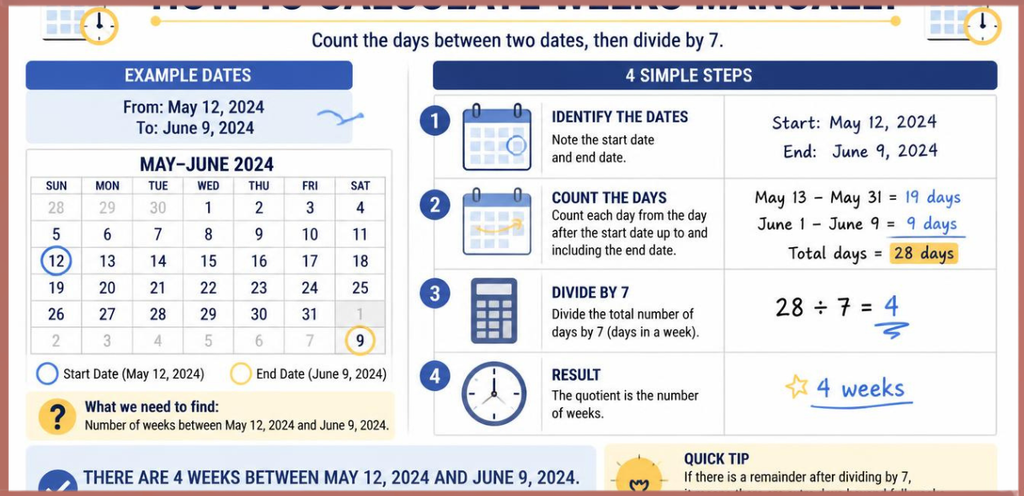
You don’t always need an online calculator. If you know the exact number of days between two dates, divide that number by seven.
For example, 28 days equals 4 weeks, while 70 days equals 10 weeks. If the total is not divisible by seven, separate the result into complete weeks and remaining days.
The difficult part is usually not the division. It’s correctly determining the number of days between two calendar dates, especially when several months or a leap year are involved. That’s why a date difference calculator can be more convenient than doing the entire calculation by hand.
For simple intervals, manual calculation is perfectly fine. For complicated date ranges, an online tool saves time and reduces the chance of a silly little error.
Choosing the Right Type of Weeks Calculator
Not every calculator is designed for exactly the same purpose. If you only want to know the number of weeks between dates, choose a tool with a Weeks Between function.
If you already know the starting date and want to move forward, look for Add Weeks to a Date. If you’re trying to discover a previous date, use Subtract Weeks From a Date.
For broader planning, a date range calculator or time difference calculator may offer more flexibility. Some tools also show days, weeks, months, and years together, which is useful when you’re working with longer periods.
The best option isn’t necessarily the one with the most buttons. Usually, it is the one that lets you enter your dates clearly answer depends on the dates. Enter both dates into the calculator rather than estimating from the number of calendar months, because months contain and understand the result without needing a small degree in calendar science.
Frequently Asked Questions About Weeks Calculators
How do I calculate weeks between dates?
Enter the Start Date and End Date into a Weeks Between Dates Calculator. The tool determines the difference and usually presents the result in weeks, days, or both.
How many weeks are between two specific dates?
The exact answer depends on the dates. Enter both dates into the calculator rather than estimating from the number of calendar months, because months contain different numbers of days.
Can I add weeks to a date?
Yes. Use the Add Weeks option, enter your starting date and the desired number of weeks, and the calculator will provide the resulting future date.
Can I subtract weeks from a date?
Yes. A Subtract Weeks function lets you enter a reference date and move backward by a chosen number of weeks.
How do I calculate weeks from today?
Use today’s date as the reference or starting date, then add the number of weeks you want. This gives you the future date corresponding to those weeks.
How do I calculate weeks ago?
Start with today’s date and subtract the desired number of weeks. A weeks ago calculation is simply a backward date calculation.
Does a weeks calculator account for leap years?
A properly designed date calculator should account for leap years when calculating the number of days between calendar dates. This is another reason automated calculations can be safer than guessing.
Can a calculator show weeks and days?
Many calculators can show both. This is useful when the date interval isn’t exactly divisible by seven and you need the remaining days as well.
How to Make Your Date Calculations More Meaningful

A calculator gives you the answer, but you can give the answer some context. Instead of simply writing “21 weeks,” record what those 21 weeks represent.
Maybe it is 21 weeks since a child was born, 21 weeks until a family celebration, or 21 weeks of progress toward a personal goal. Writing down the milestone beside the calculation can turn an otherwise forgettable number into something worth remembering.
For families preparing to welcome a baby girl, this can be particularly sweet. Keep a simple weekly note, photograph, or journal entry. The dates become a quiet timeline of anticipation, and later those little records can feel more precious than anyone expected.
Time has a funny habit of becoming visible only after it has passed. A week difference that seemed ordinary today can become a treasured memory years later.
Frequently Asked Question
week calculator from date
A week calculator from a date helps you find the date after or before a specific number of weeks. Enter a starting date and the number of weeks to get the result.
no of weeks calculator
A number of weeks calculator tells you how many weeks are between two selected dates. It makes calculating the time difference quick and simple.
week calculation
Week calculation is used to determine the number of weeks between dates or find a new date by adding or subtracting weeks.
weeks calculator from date
A weeks calculator from a date allows you to add or subtract a chosen number of weeks from a starting date and quickly find the resulting date.
20 weeks from today
To calculate 20 weeks from today, enter today’s date and add 20 weeks. The calculator will show the exact date that falls 20 weeks later.
R ead this blog https://brinleyo.com/week-calculator-from-date-2/
Final Thoughts on Using a Weeks Calculator
A Weeks Calculator may look like a very small piece of technology, but its usefulness reaches into some surprisingly important corners of everyday life.
It can tell you the number of weeks between dates, help you add weeks to a date, move backward with subtract weeks from a date, or simply answer the question of how long a particular period really is.
More importantly, dates are rarely just dates. Behind a starting date there might be a first appointment, a new job, a wedding, a journey, or the beginning of a pregnancy.
Behind an ending date there may be a graduation, a birthday, a holiday, or the joyful arrival of a baby girl.
Use the calculator for the mathematics, then let the moment itself carry the meaning. If you’re planning something important, save the result, mark the milestone, and perhaps write a little note beside it.
Years later, you may care less about the calculation itself and much more about what those weeks represented.
And if you’ve got a favourite way of counting down to an important date, share your experience with others. Sometimes the most memorable calendars aren’t the ones with the neatest calculations, but the ones filled with messy handwriting, family jokes, tiny celebrations, and a few dates nobody ever forgets.